
Key Takeaways
- There is no single best serverless AI infrastructure provider. The right choice depends on whether the workload needs a custom API, a Python-first application runtime, a prediction-style API, or a managed production deployment.
- For bursty inference, compare cold-start behavior, warm-capacity controls, queueing, GPU/runtime control, observability, and billing boundaries before comparing headline GPU rates.
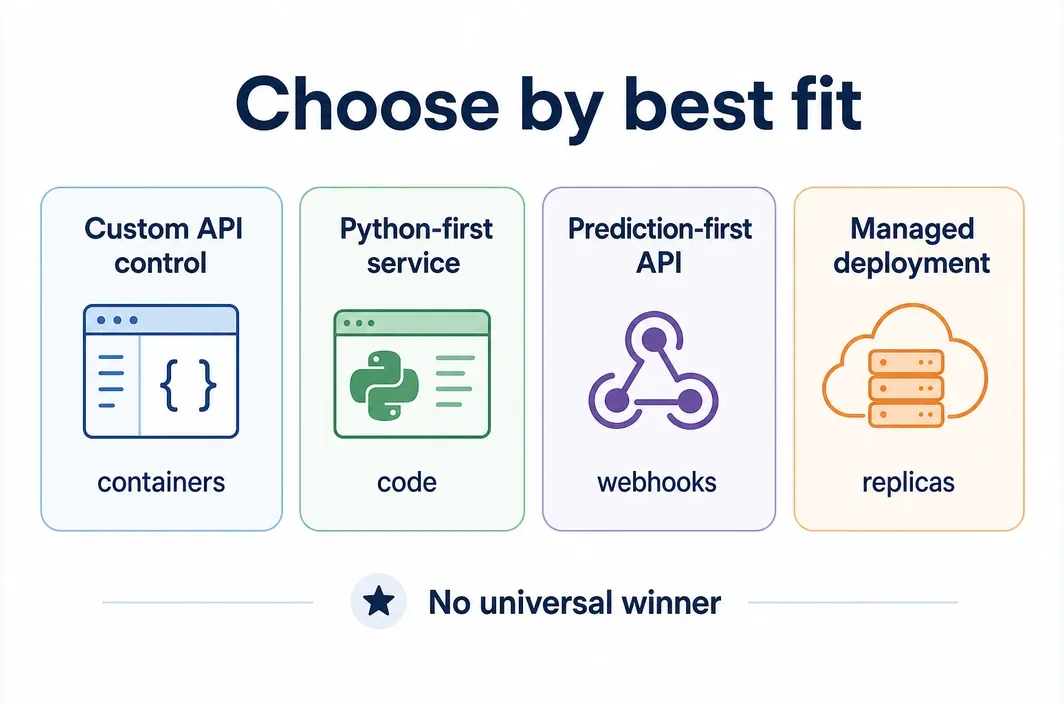
- Runpod suits teams that want container and endpoint control; Modal suits code-defined Python services; Replicate suits prediction-first delivery; Baseten suits managed production inference; and fal is worth assessing for specialized generative-model serving.
- Prices checked in July 2026 use different units and include different resources. A rate table is a budgeting starting point, not a fair provider ranking.
- Serverless is often the wrong choice for steady, high-utilization workloads, strict latency targets without paid warm capacity, or requirements that need verified networking, residency, or SLA terms.
Introduction
The best serverless AI infrastructure providers are the ones that match how an application actually runs. A team serving a custom FastAPI endpoint has a different problem from a team exposing a model prediction API, and both differ from a company that needs a managed production deployment with a defined rollout and support model.
Start with traffic shape. Serverless earns its place when demand is bursty or uncertain and paying for idle GPU capacity would be wasteful. The trade-off is that an inactive worker may need to acquire compute, start a container, and load model state before it can serve a request. Keeping workers warm reduces that delay, but it changes the cost model.
That makes a generic “top provider” list misleading. The useful question is: which platform gives the application the right control surface and the least operational friction for its workload?
What “serverless AI infrastructure” should mean
For AI workloads, serverless infrastructure is more than a GPU behind an HTTP URL. It is a request-driven execution model in which a platform provisions and retires workers, exposes an endpoint or job interface, and manages at least part of scaling. The team still needs to decide how models are packaged, how requests queue, where weights live, and what happens during a cold start.
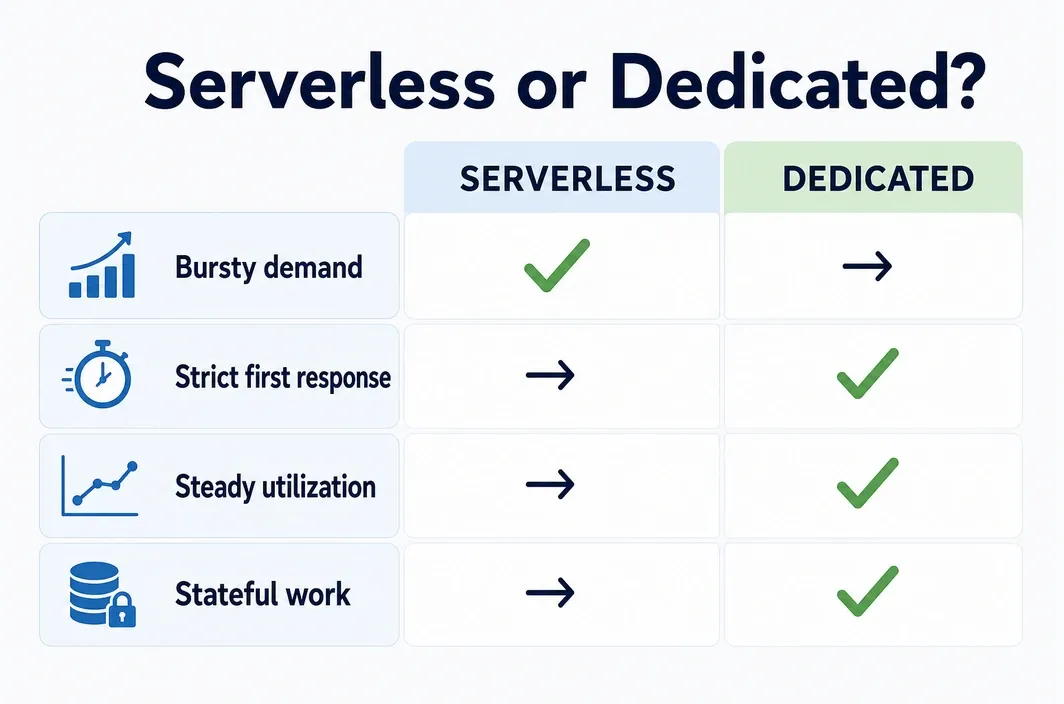
The distinction from a dedicated GPU instance matters because the operating model is different.
| Dimension | Serverless AI infrastructure | Dedicated GPU instance or Pod |
|---|---|---|
| Capacity | Expands or contracts with demand within configured limits | Reserved for the running period |
| Best traffic shape | Bursty, asynchronous, event-driven, or uncertain demand | Predictable, sustained, stateful, or iterative work |
| Startup behavior | May cold-start unless warm workers or cached state are maintained | Environment can stay running and warm |
| Primary engineering task | Configure endpoints, scaling, concurrency, and request lifecycle | Operate the environment, process manager, and capacity schedule |
| Cost question | What is billed during execution, deployment, scaling, and warming? | What is billed while the instance is allocated, including idle time? |
The word “serverless” does not remove infrastructure constraints. Large model weights, private dependencies, GPU availability, concurrent requests, and data movement still affect first-request latency and cost. Runpod’s Serverless overview, for example, describes cold starts as worker startup plus container and model initialization. Modal’s LLM inference guide similarly treats model-loading time as a design constraint rather than a detail to ignore.
Use serverless when the platform can absorb the operational work you do not want to own, while still giving enough control over the pieces that determine application behavior.
The evaluation criteria that actually matter
Evaluate platforms against the workload before opening a pricing page. The following criteria expose the trade-offs that a feature checklist can hide.
| Criterion | What to ask | Why it changes the choice |
|---|---|---|
| Workload shape | Is it queued batch work, an interactive API, streaming, or scheduled processing? | Queued jobs can tolerate a different scaling path from synchronous requests. |
| Runtime control | Do you need a custom container, custom routes, or a fixed model API? | Control can reduce platform lock-in, but increases responsibility for tuning. |
| Queueing and retries | Does the platform queue work, retry failures, or send traffic directly to workers? | A direct HTTP endpoint may be right for streaming but may shift backpressure handling to the application. |
| Cold start and warm capacity | What starts cold, how are weights cached, and what does one warm worker cost? | The first-request experience and the idle bill are connected. |
| Scaling controls | Can you set minimum/maximum workers, concurrency, timeouts, and scale-down behavior? | Defaults rarely match a model’s memory and latency profile. |
| Observability | Can you see queue delay, latency, errors, worker state, and GPU use? | Capacity tuning without production signals is guesswork. |
| Commercial boundary | Are the rates per second, minute, request, token, or deployment state? What else is billed? | A lower-looking rate can cover a different resource bundle or lifecycle. |
For an LLM endpoint, test at least two traffic patterns: a cold request after an idle period and a short burst at the expected concurrency. Record time to first useful response, queue time, execution time, error behavior, and billable duration. For batch image or video work, test asynchronous submission, webhook/polling behavior, output retention, and retry semantics.
Top providers by best-fit use case
The following providers are credible starting points, not an ordinal ranking. Confirm the live product page, available GPU type, region, and billing terms before a production commitment.
| Provider | Best fit | Main abstraction | Practical trade-off | Current official starting point |
|---|---|---|---|---|
| Runpod | Teams needing custom containers and a choice between queued jobs and direct HTTP workers | Serverless endpoints and workers | Load-balancing endpoints trade built-in queueing for direct worker access; cold-start behavior needs workload testing | Endpoint docs distinguish queue-based async/sync work from load-balanced custom HTTP services. |
| Modal | Python teams building custom functions, web apps, batch jobs, or GPU services in code | Python-defined functions, classes, and web endpoints | Runtime control is code-first; model startup and concurrency settings still need tuning | Docs describe per-second execution and code-defined container/GPU configuration. |
| Replicate | Product teams that prefer predictions, webhooks, and managed model deployments | Models, predictions, and deployments | The easiest prediction path is more opinionated; distinguish public-model usage from dedicated deployments | Deployments expose min/max instances, autoscaling, and operational metrics. |
| Baseten | Teams that want managed production inference with configurable replica behavior | Dedicated model deployments and autoscaling | Production features can come with a more managed deployment model and distinct billing lifecycle | Autoscaling exposes replica bounds, scale-down behavior, and concurrency-related controls. |
| fal | Generative-model workloads that fit its model-serving and private-serverless abstraction | Serverless functions and model-serving APIs | Verify the exact model, persistence, and pricing path; isolated invocation is not the same as a persistent service | Docs describe isolated functions, keep_alive, shared /data, and model-cache behavior. |
Choose the provider category first, then obtain a workload-specific estimate. A small API with spiky traffic may reward scale-to-zero. A latency-sensitive endpoint may need one or more warm workers and should be judged on a realistic monthly utilization curve, not a single GPU-hour.
Where RunC belongs in this list
RunC.ai, referred to below as RunC, belongs on a conditional shortlist for teams that want to evaluate a serverless path while retaining the option of GPU Pods for longer-lived development, model preparation, or iterative workloads.
Use the following evaluation gate before committing an application to RunC Serverless GPU:
| Check | What to verify | Decision consequence |
|---|---|---|
| Preview workflow | Confirm the current console/API path, supported runtime, and endpoint lifecycle in official docs or the product console | Do not assume feature parity with established serverless products. |
| Scaling and latency | Run a cold-start and burst test using the exact image, model weights, concurrency, and region required | Keep a Pod or another deployment path available if the test misses the target. |
| Cost boundary | Confirm Serverless billing, warm-capacity behavior, storage, and any ancillary charges at the time of purchase | Do not use Pod pricing as a Serverless price proxy. |
| Persistent work | Decide whether model preparation, repeated experimentation, or stateful development is better kept on GPU Pods | Use Pods when an always-available environment is the simpler operating model. |
For that second path, RunC documentation covers GPU instance management and Network Volumes. A Pod can be useful when work needs a persistent environment rather than request-driven scale-to-zero behavior. Network Volumes should be evaluated for reuse of data and model assets, not treated as a substitute for a long-term backup plan.
RunC does not need to win every row of a provider matrix to be useful. The credible case is narrower: test the Preview serverless surface for an event-driven workload, and compare it with a Pod-based path when the application needs a durable development or operating environment. Do not infer current GPU inventory, regions, observability, networking, SLA, compliance, or price from this high-level positioning.
When serverless is the wrong answer
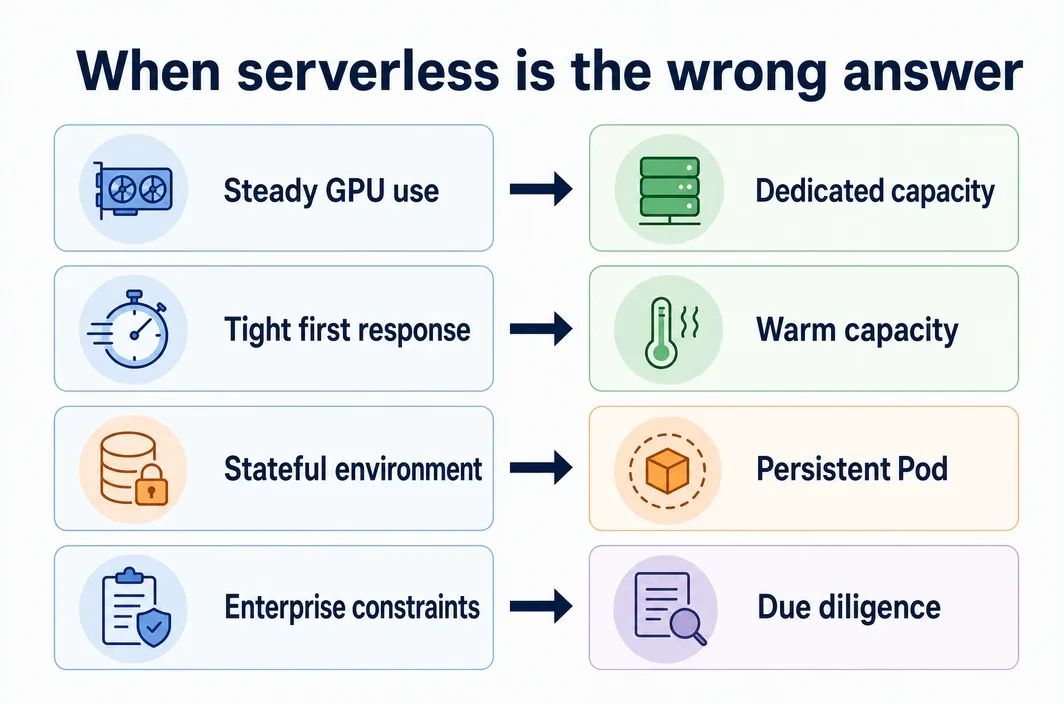
Serverless is not automatically cheaper or simpler. It can be the wrong architecture when the workload needs continuity more than elasticity.
| Situation | Better starting point | Why |
|---|---|---|
| Stable, high GPU utilization for long periods | Dedicated instance, Pod, or reserved-capacity comparison | The zero-idle benefit shrinks when capacity is busy most of the time. |
| A strict first-request or streaming latency target | Warm capacity or dedicated serving | Cold starts, model loading, and scale-up must be eliminated or measured within the target. |
| Stateful services or iterative development environments | Persistent GPU environment | Reconstructing state on every invocation can add complexity and cost. |
| Private networking, residency, compliance, or contractual SLA requirements | Vendor due diligence and an architecture review | Product pages do not prove that a specific deployment satisfies those requirements. |
| Very large models with long initialization | Dedicated or intentionally warm deployment | A scale-to-zero design can shift unacceptable startup time to the first caller. |
Use a basic cost model instead of comparing rate cards alone:
monthly delivery cost = billable GPU time + warm-capacity time + CPU/memory/storage + deployment/scale time + engineering time from retries and operations
For a bursty workload, serverless can reduce idle GPU spend. For a consistently busy workload, a dedicated path may be more predictable. Run a small proof with real model weights and traffic before treating either result as permanent.
FAQ
Which serverless AI provider is best for a custom inference API?
Runpod and Modal are common starting points when you need to control a custom container or application interface. Choose between them by testing the runtime model, queueing behavior, scaling controls, and the team’s preferred development workflow.
Is serverless GPU infrastructure cheaper than a dedicated GPU?
It can be cheaper for bursty demand because idle capacity can scale down. It can be more expensive or less predictable when you must keep workers warm, initialize large models frequently, or run at a high steady utilization.
Why are serverless GPU prices hard to compare?
Providers may bill by second, minute, request, token, output, or deployment state, and include different CPU, memory, storage, and support boundaries. Compare a realistic workload bill, not just an advertised GPU rate.
When should a team avoid scale-to-zero?
Avoid it when a cold request cannot meet the application’s latency target or when model initialization is too long. Keep warm capacity or use dedicated serving after measuring the actual startup path.
Is RunC Serverless ready for every production API?
Not necessarily. Before relying on it for a production API, verify that its endpoint workflow, scaling controls, capacity, pricing, and real-world workload behavior meet your requirements.
Conclusion
Choose serverless AI infrastructure by operating model, not by a generic leaderboard. Match custom API control, Python workflow, prediction abstraction, managed deployment needs, and traffic shape to the provider that exposes the right controls. Then test cold and warm behavior with the real model before committing a budget.
If an event-driven workload also needs a practical path to persistent GPU environments, evaluate the current RunC.ai Serverless GPU alongside GPU Pods. Keep the proof of fit in the workload test: latency, billed lifecycle, model setup, and the operating constraints that matter to the application.

Member discussion: