
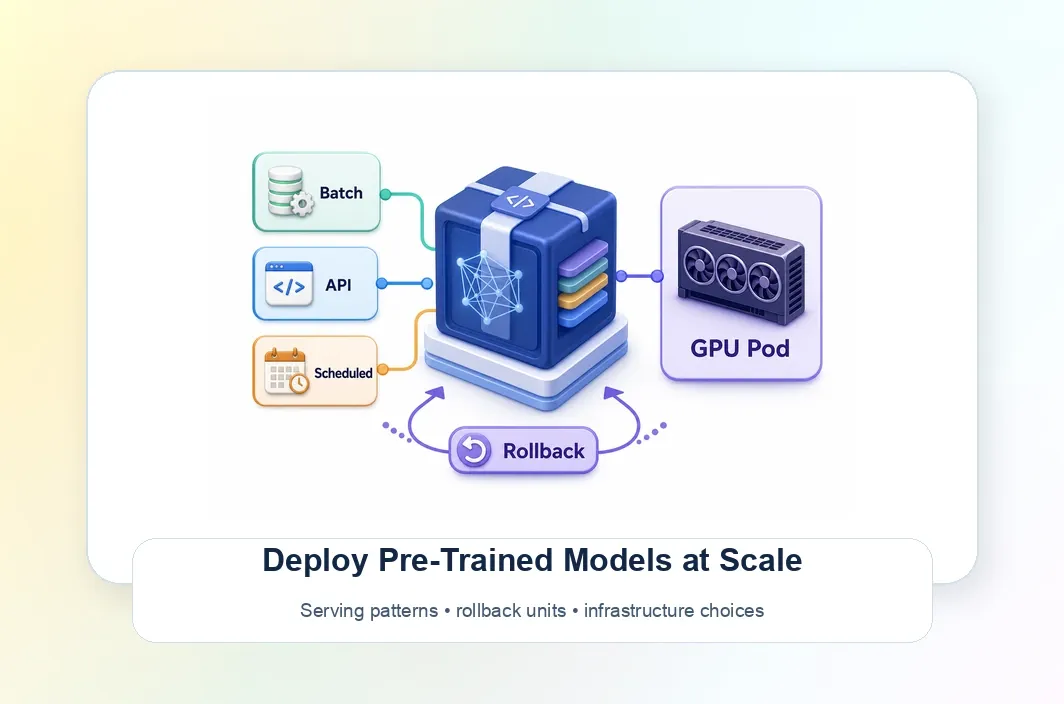
Key Takeaways
- Start by classifying the deployment as
batch,API, orscheduled job; the serving pattern controls latency, scale, retry, and monitoring decisions. - Define the rollback unit before traffic grows. Model weights, tokenizer/config, runtime, container, dependencies, and serving contract should move together.
- Choose infrastructure after the workload and artifact boundary are clear. Managed endpoints, serverless paths, scheduled runners, and persistent GPU Pods solve different operating problems.
- Treat rollout, rollback, monitoring, and cost controls as part of the deployment design, not cleanup work after launch.
Introduction
Deploying a pre-trained model at scale is not mainly a question of having a checkpoint ready. The real decision is how that model should operate once it leaves a notebook: as a batch job, a live API, or a scheduled run that must finish inside a predictable window.
That is why this should not be treated as a generic MLOps checklist. The deployment memo has to settle three practical questions early: what serving pattern fits the workload, what exact artifact rolls back when a release fails, and how much infrastructure control the team needs before the deployment becomes hard to operate.
Once those answers are clear, platform choice becomes much less abstract. A managed endpoint, a serverless path, a scheduled runner, and a persistent GPU environment are not interchangeable labels; they are different answers to latency, state, rollback, debugging, and cost-risk constraints.
What Changes When a Pre-Trained Model Leaves the Notebook
A notebook hides many deployment assumptions. It may use a local Python environment, cached model files, a developer's file paths, and a small test input that never exposes concurrency or data-volume problems. None of those assumptions are safe once the model is part of a production workflow.
The first production change is dependency pressure
A tokenizer version, CUDA image, inference server, preprocessing library, or environment variable can change behavior even when the model weights stay the same. If the team cannot rebuild the runtime consistently, scaling only makes errors harder to reproduce.
The second change is that the model now has an operating mode
It is no longer just "running inference." It is completing a batch job, responding to API traffic, or finishing a scheduled task inside a predictable window. Each mode creates different constraints around latency, queueing, retries, and rollback.
The third change is ownership
Someone has to know what was deployed, where the model artifact lives, what metrics define failure, and how to revert safely. Without that release boundary, a production incident becomes a guessing game between model quality, runtime drift, and infrastructure behavior.
A useful deployment stage split looks like this:
| Stage | Decision to make | Failure if skipped |
|---|---|---|
| Prototype exit | What workload shape is this? | Platform is chosen before the runtime problem is known. |
| Artifact packaging | What is the deployable and rollback unit? | Bad releases cannot be reproduced or reverted cleanly. |
| Infrastructure selection | Does the workload need persistent control such as RunC.ai? | Team overbuilds or under-controls the deployment. |
| Rollout | How does traffic or job volume move to the new version? | Production regressions hit all users or all jobs at once. |
| Operations | Which signals prove health, cost, and output quality? | Failures are noticed late or explained poorly. |
That deployment-stage view keeps the work focused on release decisions rather than a broad explanation of pre-trained models.
Choose the Serving Pattern Before You Pick the Platform
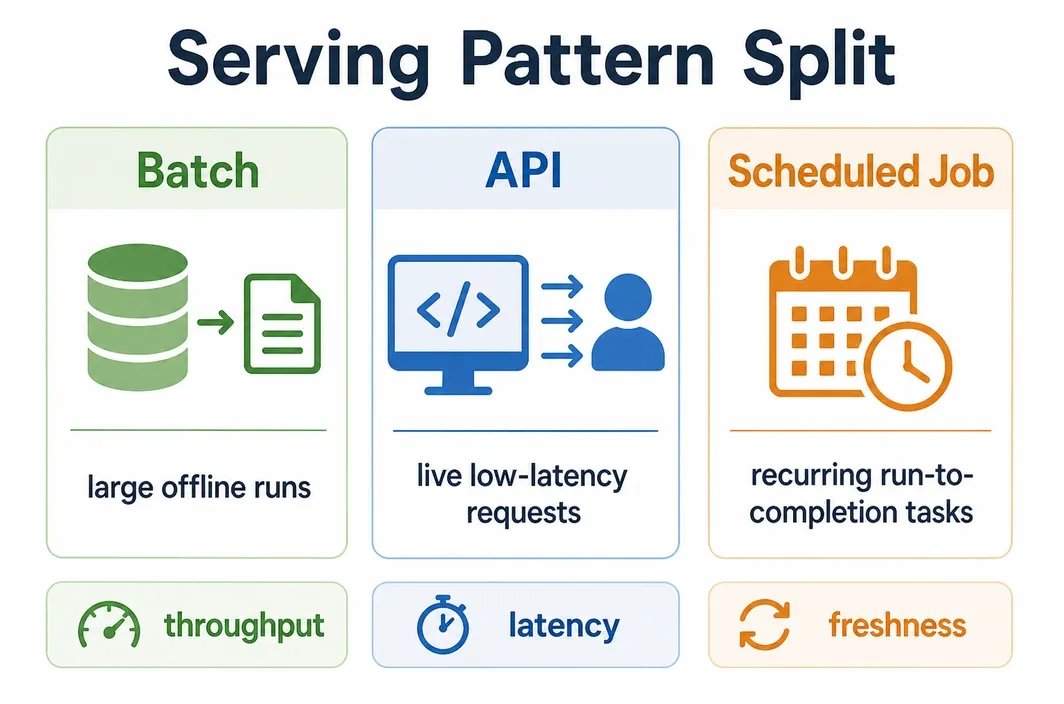
The most important early decision is whether the workload is batch, API, or scheduled job. These are not just implementation labels. They describe how the model is used, how users experience delay, and which failure modes matter most.
| Serving pattern | Best fit | Scale signal | Primary risk | Artifact and rollback need |
|---|---|---|---|---|
Batch |
Offline scoring, backfills, dataset labeling, evaluation runs | Input size and total completion time | Slow jobs, bad records, expensive reruns | Version the model, runtime, input schema, and output format together. |
API |
Live applications, chat, search, recommendations, real-time scoring | Requests per second, latency, concurrency | Latency spikes, error bursts, degraded responses | Roll back the model and serving runtime as one release. |
Scheduled job |
Nightly refresh, periodic indexing, recurring report generation | Run duration, missed schedules, backlog | Missed windows or stale downstream data | Track job definition, runtime, model version, and schedule together. |
Batch inference is appropriate when users do not need an immediate response. API serving is appropriate when the model sits behind a product experience and must respond quickly. Scheduled jobs are useful when the workload is recurring but not always-on, such as a nightly classification run or a periodic embedding refresh; Google Cloud's Cloud Run scheduled jobs documentation is a useful reference for that run-to-completion pattern.
Choosing the pattern first prevents a common mistake: comparing platforms before defining the job. A managed endpoint may be the simplest answer for stable API traffic. A scheduled runner may be cleaner for recurring run-to-completion work. A persistent GPU environment may make sense when the same heavy workload repeatedly needs the same model files, custom runtime, and debugging path.
The serving pattern also controls the language of monitoring. For batch, completion rate and throughput may matter more than latency. For APIs, latency, error rate, and concurrency pressure are central. For scheduled jobs, missed runs and downstream freshness are usually more important than per-request metrics.
Lock the Artifact Boundary Before You Scale
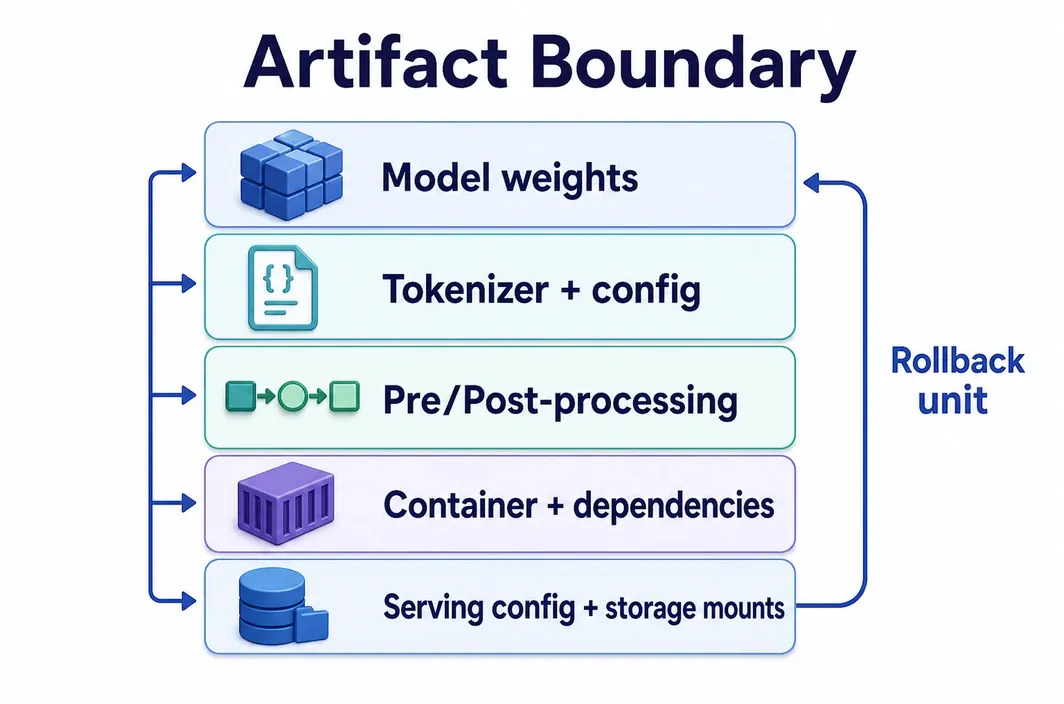
The deployable artifact is not just the model file. A pre-trained model produces reliable behavior only when its surrounding runtime is controlled. That means the artifact boundary should include every component needed to reproduce the same inference result and roll back the same release.
At minimum, the deployment boundary should include:
- model weights or model artifact version
- tokenizer, config, and model-specific loading assumptions
- preprocessing and postprocessing code
- inference server or application wrapper
- container image and dependency versions
- GPU runtime assumptions such as CUDA, drivers, and library versions
- storage mounts, model paths, and input/output schema
- deployment config that affects batching, concurrency, memory, or routing
This boundary matters because rollback should be a product operation, not an investigation. If a release causes bad outputs, higher latency, or GPU memory failures, the team should know whether it is rolling back weights, code, container, serving config, or the full environment.
| Rollback target | What it fixes | What it does not fix |
|---|---|---|
| Model artifact | Bad model version, wrong checkpoint, changed tokenizer pairing | Runtime dependency or serving-code failures |
| Container image | Broken dependency, CUDA/library mismatch, packaging regression | Bad model quality or wrong input contract |
| Serving config | Poor batching, concurrency limits, memory pressure | Bad model artifact or code logic |
| Full environment | Combined runtime, storage, and serving-state issues | Upstream application logic outside the deployment |
This is where many deployments become fragile. A team says it can roll back the model, but the real release includes hidden preprocessing code, manually staged files, or an undocumented runtime image. At small scale that may be tolerable. At scale it turns routine deployment into incident response.
The safer pattern is to define the rollback unit before traffic grows. Treat the model, runtime, and serving assumptions as one release contract. Then infrastructure choice becomes more concrete: the team knows what must be moved, reproduced, monitored, and reverted.
Infrastructure Decision Matrix: Managed Endpoint, Serverless Path, Scheduled Runner, or Persistent GPU Pod
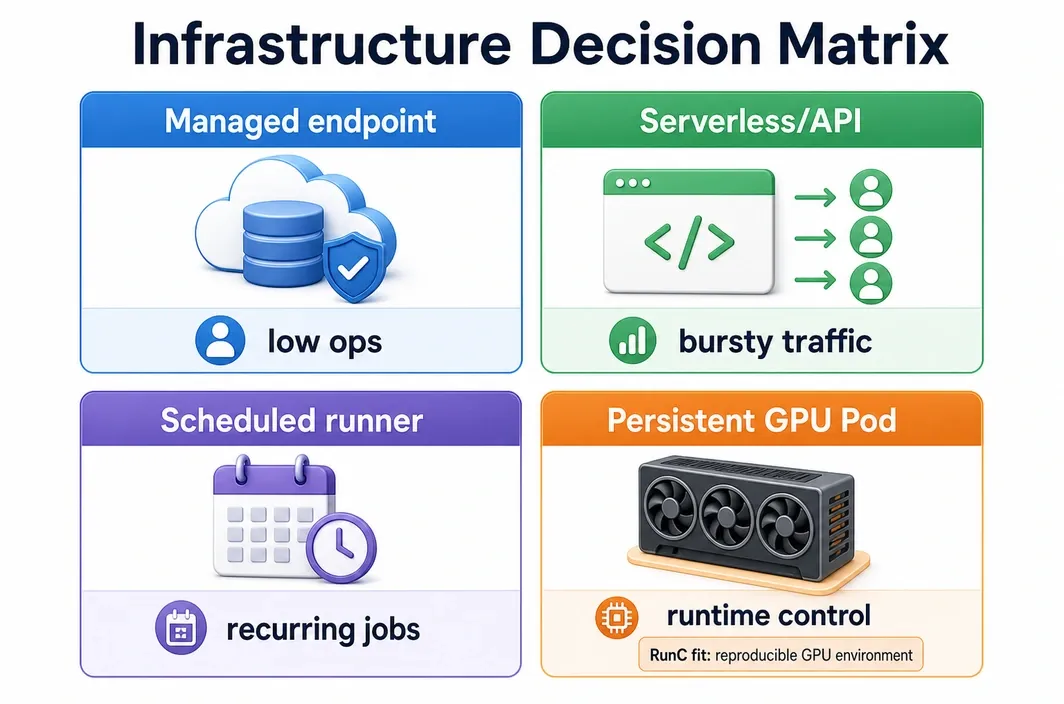
Once workload shape and artifact boundary are clear, infrastructure can be evaluated honestly. The question is not which option is universally best. The question is which option gives the right balance of control, state, rollback visibility, and operational burden for this deployment.
| Infrastructure path | Best fit | Control level | State and storage assumption | When not to use | Persistent GPU fit |
|---|---|---|---|---|---|
| Managed endpoint | Stable API serving that fits provider packaging and monitoring | Low to moderate | Provider manages most serving behavior | Avoid if custom runtime, deep debugging, or reusable local state is central. | Low unless the team needs more GPU/runtime control. |
| Serverless/API path | Bursty or event-driven inference with low idle tolerance | Moderate | Usually assumes disposable workers and externalized state | Avoid for workloads with heavy warm state, large model staging friction, or strict custom runtime needs. | Possible fit for event-driven GPU serving, but do not treat it as the default for every model. |
| Scheduled runner | Recurring run-to-completion inference jobs | Moderate | Job state is usually recreated each run; artifacts must be staged reliably | Avoid for always-on interactive serving. | Useful only if scheduled work later needs persistent GPU state or shared artifacts. |
| Persistent GPU Pod | Recurring GPU-backed workloads with custom runtime, repeated debugging, and reusable model/data assets | High | Runtime and mounted assets can persist across work loops | Avoid for low-frequency, one-off, or simple managed workloads. | Strong fit when GPU Pods, templates, SSH/JupyterLab access, and Shared Network Volumes support a reproducible serving environment. |
By this point, the workload pattern and artifact boundary are clear enough to evaluate product fit. The remaining question is whether the deployment needs persistent environment control.
In the persistent GPU Pod branch, RunC.ai, referred to below as RunC, is relevant because it gives teams a place to keep GPU runtime, model assets, debugging access, and deployment work together. GPU Pods help when the workload repeatedly returns to the same runtime. Templates reduce setup repetition for common AI stacks. SSH and JupyterLab access matter when operators need to inspect the real environment instead of guessing through a narrow abstraction. Shared Network Volumes matter when model weights, datasets, or generated artifacts need to stay available across Pods or repeated runs.
That does not make persistent Pods the answer for every pre-trained model. If the workload is low-frequency, simple, or already fits a provider-managed endpoint, lighter infrastructure is probably better. The point is to use persistent GPU environments when recurrence, control, and reproducibility justify the extra ownership.
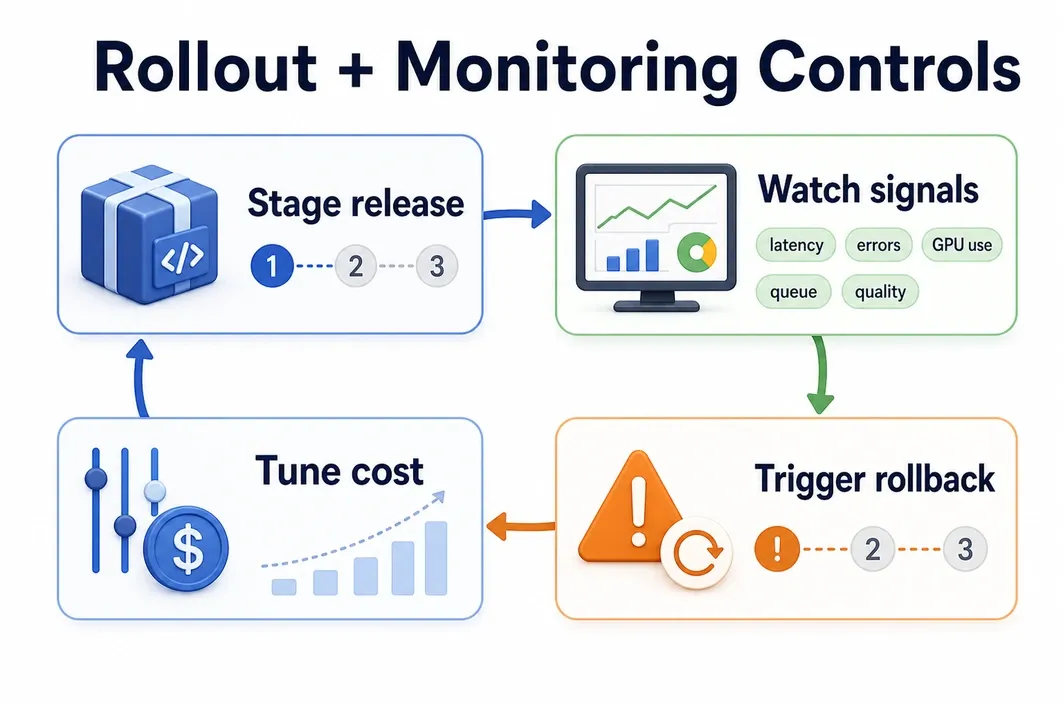
Rollout, Rollback, Monitoring, and Cost-Risk Controls
Scaling a pre-trained model safely requires more than launching the chosen runtime. The team needs a rollout plan, a rollback trigger, and monitoring that matches the serving pattern.
For an API, staged rollout can mean sending a small percentage of traffic to the new model version before expanding. For batch or scheduled jobs, staged rollout may mean running the new version on a limited dataset, a non-critical region, or a single recurring job before promoting it broadly. The mechanism changes, but the principle stays the same: do not make the first production exposure the full production blast radius.
Rollback also needs a trigger. A rollback trigger can be latency above threshold, error rate above threshold, GPU memory failures, queue backlog, missed job window, unexpected output-quality regression, or cost per run exceeding the expected range. The trigger should be known before release, not invented during the incident.
| Control area | What to monitor | What failure usually means | Practical response |
|---|---|---|---|
| Latency and throughput | p50/p95 latency, requests per second, batch completion rate | Runtime or batching does not match workload shape | Tune batching/concurrency or move to a better-fit infrastructure path. |
| Reliability | error rate, failed jobs, retry volume, missed schedules | Bad release, resource pressure, or upstream contract mismatch | Roll back artifact, serving config, or job definition. |
| GPU utilization | utilization, memory use, queue depth | GPU is oversized, undersized, or poorly fed | Resize, batch better, or change serving pattern. |
| Cost | idle time, cost per request, cost per run | Infrastructure path is too heavy or utilization is weak | Move low-frequency work to lighter paths; reserve persistent Pods for recurring control needs. |
| Model behavior | output-quality checks, bad-record samples, drift signals | Model or preprocessing changed behavior | Roll back model artifact or preprocessing boundary. |
Cost control should be handled with the same specificity. Managed endpoints may be efficient when the provider abstraction fits. Serverless paths can reduce idle cost for intermittent work but may introduce cold-start or state-management constraints. Persistent GPU Pods can reduce repeated setup friction for recurring workloads, but they need utilization discipline. If a Pod sits idle because the workload is rare, the team chose too much infrastructure for the current stage.
The best practices for deploying pre-trained models at scale therefore end with a simple discipline: define the serving pattern, package the release boundary, choose the least complicated infrastructure that gives enough control, and monitor the exact signals that would justify rollback.
FAQ
What is the first step in deploying a pre-trained model at scale?
Classify the workload as batch, API, or scheduled job. That choice determines latency expectations, monitoring needs, rollout style, and which infrastructure paths make sense.
What should be included in the model artifact boundary?
Include the model weights, tokenizer or config, preprocessing and postprocessing code, runtime dependencies, container image, serving config, and storage assumptions. The goal is to make the release reproducible and rollback practical.
When do persistent GPU Pods make sense?
They make sense when the workload is recurring, GPU-backed, and benefits from a stable runtime, reusable model assets, direct debugging access, or custom environment control. They are not necessary for every simple or low-frequency deployment.
How should teams monitor model deployment at scale?
Monitor the signals that match the serving pattern: latency and error rate for APIs, completion time and bad records for batch, missed runs and freshness for scheduled jobs, plus GPU utilization, cost, and model-output quality across all modes.
Conclusion
The best practices for deploying pre-trained models at scale are mainly decisions about runtime shape, artifact boundaries, infrastructure fit, and operational control. Start by deciding whether the workload is batch, API, or scheduled job. Then define the full rollback unit, choose the lightest infrastructure path that still gives enough control, and monitor the signals that would prove the release is working.
When a workload becomes recurring enough to need reusable GPU state, shared model assets, and direct debugging access, the persistent GPU Pod branch can be the right infrastructure choice. At that stage, RunC.ai fits teams that need persistent GPU environments and tighter runtime control. For simpler or low-frequency workloads, stay with the lighter path until the workload needs more control.

Member discussion: