
Key Takeaways
- Text Generation Inference (TGI) usually means Hugging Face's toolkit for serving open-source large language models, not a model itself.
- TGI handles request routing, batching, streaming, model-server execution, and operational signals such as metrics and tracing.
- Hugging Face now lists TGI as maintenance mode. A working TGI service can remain a valid choice, but a new deployment should evaluate vLLM or SGLang against its exact model and API requirements.
- GPU selection depends on weights, context length, KV cache, concurrency, and latency targets. A model loading once is not proof that it can serve production traffic.
- A self-hosted path on RunC.ai is useful only after the runtime and capacity choices are validated; use it for a pinned container image, chosen GPU configuration, required port exposure, and reusable model data where appropriate.
- Practical decision: Do not replace a stable TGI service merely because vLLM is newer. But for a new deployment, validate vLLM first and choose TGI only when its tested compatibility or operational fit gives it a clear advantage.
Introduction
Text Generation Inference, usually shortened to TGI, is Hugging Face's serving stack for open-source LLMs. It sits between an application and the model: it accepts generation requests, schedules and batches work, runs model servers, and streams responses back to the client.
That definition matters because "the model can generate text" and "the model can run a dependable service" are different problems. The second requires a compatible runtime, a capacity plan for context and concurrent requests, monitoring, and a deployment path that can be reproduced. TGI can still fill that role, but its maintenance-mode status changes the decision for a new service.
What TGI is
TGI is a toolkit for deploying and serving popular open-source LLMs. It is not an LLM, a model hub, or a hosted endpoint by itself. It is the runtime layer that turns compatible model weights into a service your application can call.
Hugging Face documents three main moving parts. The router receives client requests and manages batching and scheduling. The launcher starts the router and one or more model servers. Each model server loads the model and performs inference; when a model is sharded across accelerators, the shards coordinate through a distributed communication layer.
This separation is useful operationally. The router can combine work from several requests, while the model server focuses on executing the selected model. It also explains why a successful model download is only the first check: the application still needs to validate request handling, response streaming, limits, observability, and behavior under a realistic load.
There is one current caveat that should shape a new deployment. Hugging Face marks text-generation-inference as being in maintenance mode and recommends considering engines such as vLLM and SGLang going forward. That does not mean an existing, tested TGI installation must be removed. It means a team starting today should treat TGI as a compatibility and maintenance decision, not as an automatic default.
Before choosing any runtime, check the exact model revision, tokenizer or chat template, quantization, CUDA/driver/image combination, and API behavior you need. TGI publishes a supported-model list; a model outside its optimized paths may run, but its performance is not guaranteed.
The core features that make TGI production-relevant
TGI remains relevant because it addresses several serving concerns that application code should not have to rebuild. Each feature helps only when it is matched to a real workload constraint.
- Continuous batching. TGI can group in-flight requests so the GPU does more useful work across the queue. That can increase aggregate throughput, but a batch policy also affects queueing and tail latency. It is a tradeoff to measure, not a free speed boost.
- Token streaming. Server-Sent Events (SSE) let an application receive generated tokens incrementally. This is valuable for interactive chat or coding experiences where time to first token matters more than waiting for a full response.
- Tensor parallelism. A compatible model can be split across multiple GPUs so a larger model or a larger serving footprint is possible. It adds sharding and topology requirements; setting a GPU-count flag is not enough evidence that a model, image, and node configuration will work together.
- Quantization and weight loading. TGI supports several optimized paths, but a lower-precision format changes model compatibility, memory behavior, and sometimes output or kernel requirements. Test the exact model and image rather than relying on the model's parameter count.
- Observability. TGI exposes Prometheus metrics and supports OpenTelemetry tracing. These signals make it possible to observe request errors, batch behavior, inference duration, queue pressure, memory headroom, and latency before an incident becomes a capacity guess.
The production question is therefore not "does TGI have features?" It is whether those features match the application. A low-volume internal tool may need a simple single-replica service. A public chat endpoint may need streamed output, bounded queues, a latency budget, and a rollback plan. Both should verify supported-model behavior before capacity is purchased.
TGI vs vLLM: where each one fits
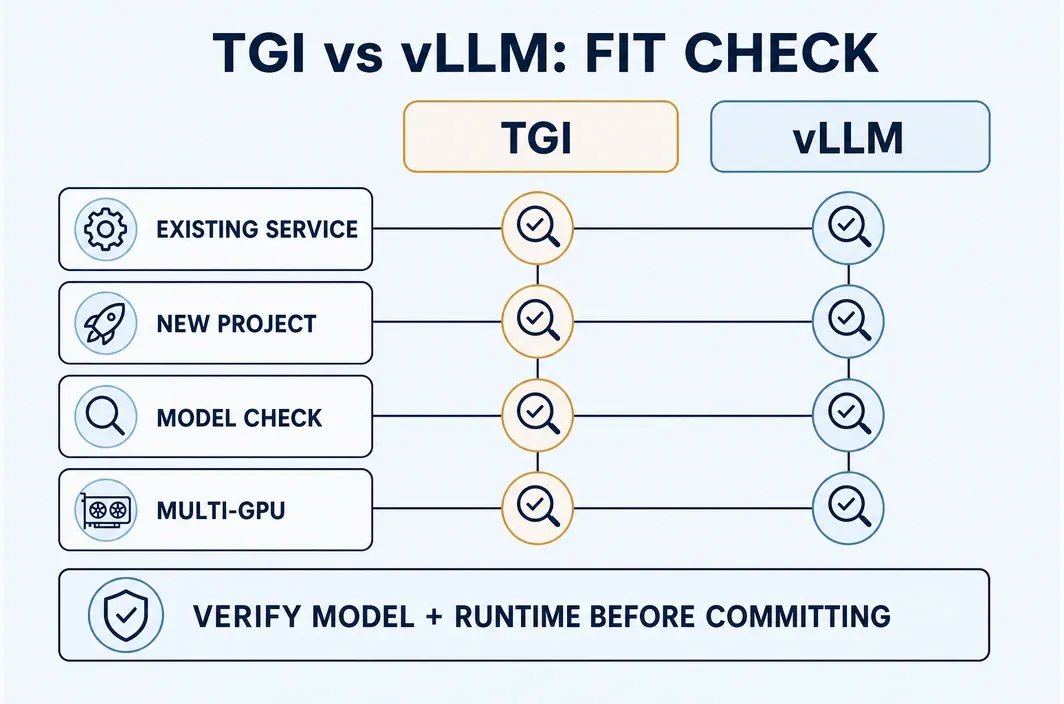
TGI and vLLM solve overlapping serving problems. The current difference that matters most is lifecycle: TGI is in maintenance mode, while vLLM is a current engine to evaluate for new deployments. That is not a universal instruction to migrate. A migration changes the runtime, model behavior, image, API surface, testing burden, and traffic-cutover plan.
| Decision factor | TGI fit | vLLM fit | Practical decision |
|---|---|---|---|
| Existing validated service | Reasonable to retain when the model, API, image, monitoring, and owner are already known. | A migration can be evaluated when there is a concrete capability or maintenance reason. | Do not migrate just because another engine is newer. |
| New service | Maintenance mode creates future-change risk. | A current option to validate first for the specific model and deployment. | Test vLLM, and SGLang where relevant, before committing to a runtime. |
| Model compatibility | Use TGI's supported-model documentation and a smoke test. | Use the current vLLM compatibility documentation and a smoke test. | No runtime is universal; verify the exact revision and feature set. |
| Multi-GPU serving | Tensor parallelism is available where the model and environment support it. | Tensor and pipeline parallelism are available where supported. | Confirm GPU count, node layout, and communication path rather than assuming a CLI option solves topology. |
| Operations and API | Streaming, metrics, tracing, and supported APIs must meet the application need. | OpenAI-compatible serving and runtime features must meet the application need. | Select the runtime your team can observe, test, and roll back safely. |
Choose TGI when an existing deployment already meets its requirements and the team accepts a maintenance plan: pin the image and model, document known limits, monitor it, and test before changing dependencies. It can be more responsible to keep a stable service than to introduce an unmeasured migration.
Choose vLLM for a new evaluation when its current feature set and model support fit the application. vLLM documents continuous batching, streaming, OpenAI-compatible serving, KV-cache management, and distributed parallelism. Those capabilities still need a model-specific test, especially if the service relies on tool calling, structured outputs, long contexts, quantization, or multi-GPU execution.
SGLang is worth considering when it matches a required runtime behavior, but it does not need to turn this into a three-way benchmark. The useful output is a short, evidence-based runtime selection record: model and revision, target API, image tag, expected context and concurrency, test result, and rollback path.
When to choose A100 vs H100 for TGI
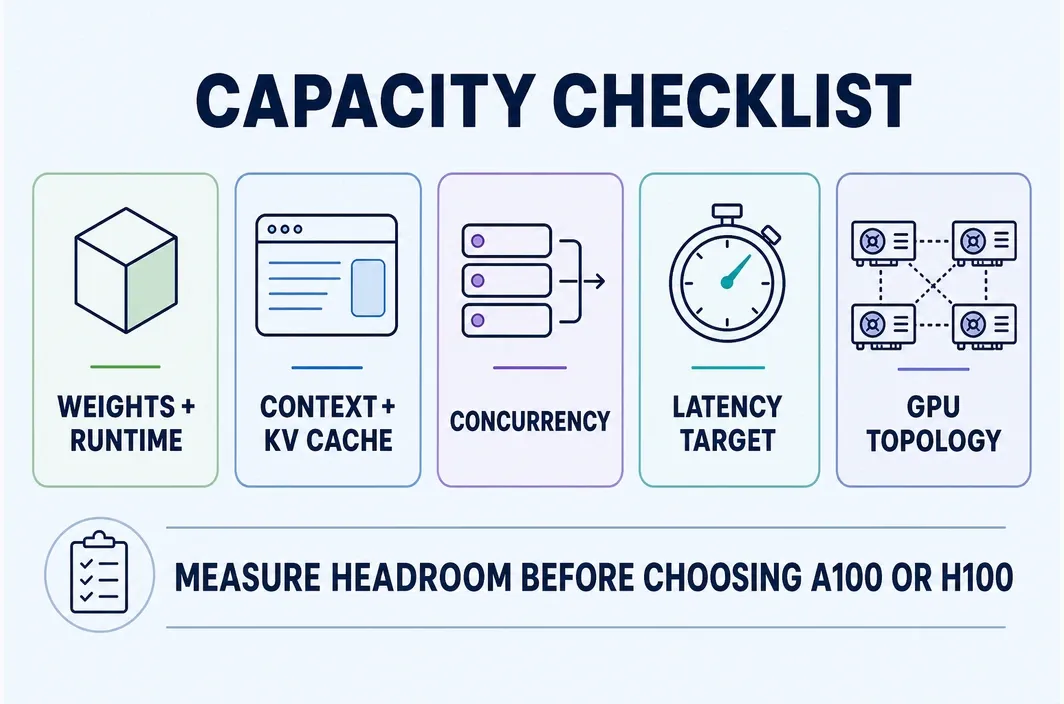
For TGI, A100 versus H100 is not a model-name decision. Both may offer 80GB-class configurations, but VRAM is only one part of serving capacity. The model weights must fit alongside runtime overhead, the active context and KV cache, and enough room for the concurrent requests that matter to the application.
Use the following checklist before selecting a tier or deciding that multiple GPUs are required.
| Validation question | Why it changes the choice | What to measure first |
|---|---|---|
| Do the weights and runtime fit with headroom? | A model that barely loads leaves little room for serving work. | Model revision, dtype or quantization, image/runtime overhead, and free memory after load. |
| What context and concurrency are required? | Long prompts and active sessions increase KV-cache demand. | Target input/output lengths, simultaneous requests, maximum tokens, and cache headroom. |
| What service behavior is required? | A batch job and an interactive API optimize for different outcomes. | Time to first token, p95 latency, throughput, queue depth, and error rate under representative traffic. |
| Is more than one GPU actually necessary? | Multi-GPU serving changes the runtime and deployment topology. | Whether a supported single-node tensor-parallel setup is enough; do not assume multi-node networking. |
| Is capacity steady or occasional? | Idle capacity can cost more than a short, measured test. | Traffic shape, model warm-up/download time, and a stop/restart plan. |
Start with the smallest configuration that can run a representative test. An A100-class path can be appropriate when the chosen model, runtime, context, and traffic profile meet the target with measured headroom. An H100-class path can be appropriate when its validated runtime support or measured time-to-result justifies the higher tier. Neither result follows from 80GB alone.
Avoid comparing TGI performance by vendor GPU labels without controlled conditions. Image versions, precision, batch policy, prompt length, generation length, cache settings, and traffic shape can all change the outcome. If a deployment needs more than one node, confirm the platform's current network and distributed-runtime requirements separately; this article does not assume any particular multi-node fabric.
How to deploy TGI on RunC
After the runtime, model, and capacity direction have passed a local or time-boxed validation, RunC.ai referred to below as RunC, can provide a self-hosted Pod path. The goal is not to treat any platform as the runtime decision; it is to make a tested container deployment repeatable.
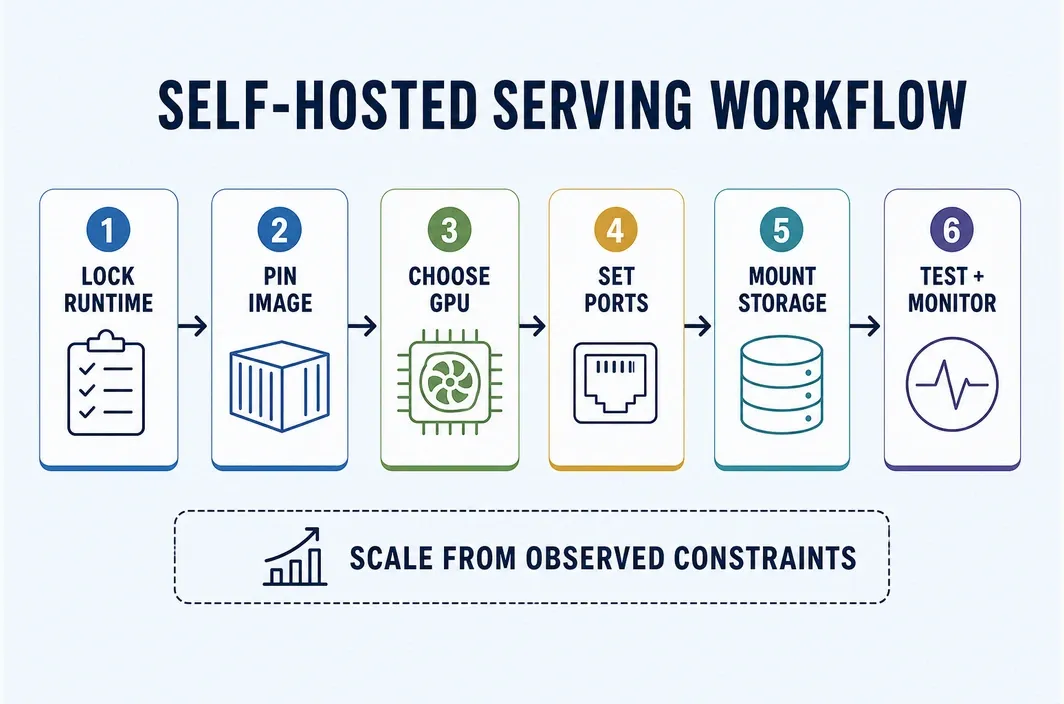
- Lock the serving contract first. Record the model revision, TGI image tag, quantization, target API, context/concurrency limit, and whether the deployment is single GPU or a validated single-node multi-GPU configuration. Do not provision around a model name alone.
- Create a Pod around that contract. RunC lets you select GPU model/count and an image. Use a pinned container image from a public or private registry rather than assuming a prebuilt TGI template exists. Confirm the live console's GPU availability, image compatibility, and pricing before deployment.
- Expose only the service port you need. RunC documents configurable HTTP/TCP port exposure. Configure the port required by the tested service, then apply your own authentication, authorization, and network-access policy. Exposing a port does not create a complete production security design.
- Plan model and cache storage deliberately. A Network Volume can be mounted to Pod instances for reusable data, but it must be in the same data center or region as the instance. Use it when repeated model downloads or reusable artifacts justify it; keep a separate backup process because RunC documents Network Volume as unsuitable for long-term backup.
- Start small and verify the service. Start the pinned image, run a health and API smoke test, and verify the expected model response before any traffic cutover. Check request errors, latency, batch/queue behavior, memory use, and restart behavior under a representative but bounded workload.
- Scale only from observed constraints. Add capacity when measured memory pressure, queueing, or latency shows that the existing configuration is insufficient. Re-check the runtime's supported topology before adding GPUs, and re-check current RunC inventory, charges, and product behavior before changing the deployment.
This path deliberately avoids a generic copy-and-paste launch command. The correct command, image, environment variables, and model-host authentication flow depend on the exact TGI release and model. Treat those inputs as release-specific implementation details, not evergreen infrastructure facts.
A simple production checklist
Before sending application traffic to a TGI service, confirm the following.
- [ ] Runtime decision: TGI is retained with an explicit maintenance plan, or an alternative runtime has passed the same compatibility review.
- [ ] Compatibility: Model revision, tokenizer/chat template, quantization, image tag, driver/CUDA requirements, and target API have passed a smoke test.
- [ ] Capacity: Representative context length, concurrency, latency, errors, and GPU/KV-cache headroom have been measured.
- [ ] Topology: The service is validated on one GPU or a supported multi-GPU layout; any multi-node assumption has independent platform evidence.
- [ ] Operations: Health checks, logs, Prometheus metrics, tracing, rollback image/model versions, and alert ownership are defined.
- [ ] Persistence: The team knows where weights, cache, logs, and outputs live, and verifies them after a restart. A Network Volume is not the only backup plan.
- [ ] Access and cutover: Port exposure, application authentication, authorization, rate limits, and the traffic-switch plan are owned by the deployer.
FAQ
Is TGI the same as Hugging Face Inference Endpoints?
No. TGI is an inference engine and serving toolkit. Inference Endpoints is a hosted product that can use an engine such as TGI or another supported engine behind the managed endpoint.
Is TGI still suitable now that it is in maintenance mode?
It can be suitable for a stable deployment whose exact model, image, API, and operating procedures are already validated. For a new service, evaluate vLLM or SGLang as well, because maintenance mode increases the risk of relying on TGI for future feature or model changes.
When do I need tensor parallelism for text generation serving?
Consider it when the required model/runtime footprint does not fit with useful headroom on one GPU, or when a validated workload needs more capacity. Confirm model support, GPU count, and the actual deployment topology before enabling it.
Do I need an A100 or H100 for TGI?
Not automatically. Choose from measured model memory, context length, KV cache, concurrency, and latency behavior. A smaller or lower-cost configuration can be sufficient for a bounded workload; an 80GB-class path is justified only when the evidence requires it.
Can I deploy a custom TGI image on RunC?
RunC documents container-image deployment from public or private registries and configurable ports on instances. Confirm the current console workflow, image compatibility, GPU availability, and access controls before creating the Pod.
Conclusion
TGI is a capable LLM-serving toolkit, but the right decision in 2026 starts with its maintenance-mode status. Keep it when a tested service meets the need and you can own the maintenance plan; for a new deployment, evaluate a current runtime against the exact model and application behavior.
Once that choice is made, measure capacity with realistic contexts and concurrent requests, then deploy the smallest configuration that passes the test. For a self-hosted path on RunC.ai, use a pinned image, a deliberate storage plan, a limited service exposure, and a health/metrics check before scaling beyond the first controlled deployment.

Member discussion: