
Key Takeaways
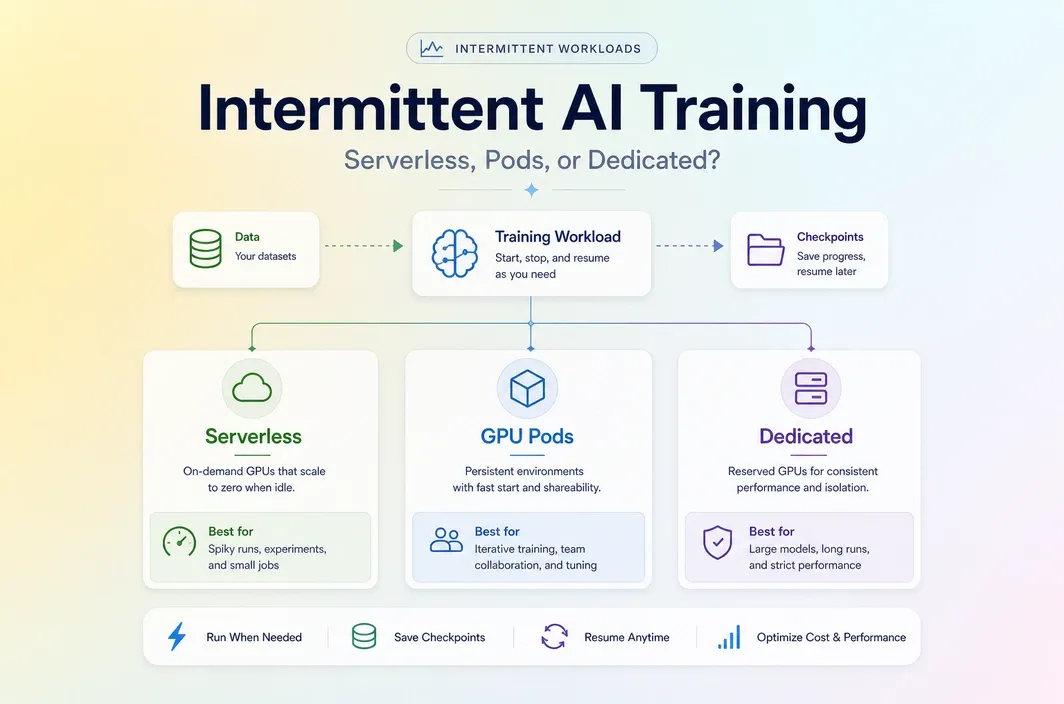
- Intermittent AI training rarely comes down to a simple
serverless vs dedicatedanswer. In practice, many teams also need to consider a persistent middle option such as GPU Pods. - The right deployment model depends on job frequency, checkpoint size, startup tolerance, and how much repeated environment setup the workflow can absorb.
- Serverless-style capacity works best for occasional runs with low persistence requirements. Dedicated instances work best when usage is frequent enough to justify always-on control.
- RunC.ai is useful in this category because it lets teams compare Serverless GPU and GPU Pods within the same operating context instead of treating infrastructure choices as separate ecosystems.
Introduction
Intermittent AI training looks simple until the hidden costs show up. On paper, the cheapest answer often seems obvious: do not keep GPUs running when you are not training. In practice, the workload may still pay for delay in model setup, data movement, image startup, or repeated environment reconstruction. That is why serverless vs dedicated instances intermittent ai training workloads is really a deployment-economics query, not just infrastructure vocabulary. The reader wants to know whether occasional training should stay lightweight, move into a persistent pod model, or justify dedicated instances anyway.
A useful answer has to connect training frequency with operational friction. Otherwise the article becomes generic cloud advice that does not help anyone make the decision.
A Quick Decision Framework for Intermittent AI Training
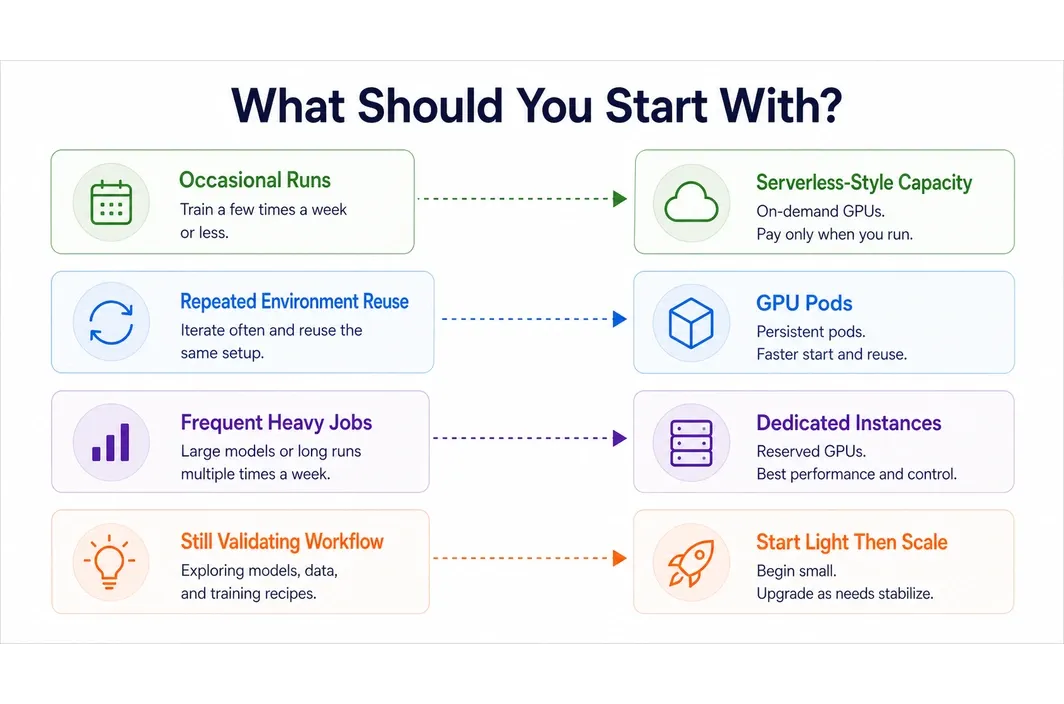
Start with how often jobs actually run. If training happens occasionally and the environment is simple to reconstruct, a lighter-weight on-demand model can make sense. If jobs keep returning to the same runtime, the same datasets, and the same checkpoints, persistence quickly becomes more valuable than theoretical idle savings. That is the core of the serverless vs dedicated instances intermittent ai training workloads decision. The second question is how expensive the restart cycle is. Some training jobs do not mind warm-up time. Others repeatedly pay a penalty in data mount time, image load time, and environment recovery. Once that pattern becomes frequent, “only pay when running” stops being the whole story.
The third question is how much control the workload needs. If the team is still experimenting, a lower-friction setup is usually smarter. If the workflow is mature and repeatable, more dedicated infrastructure may produce better operational stability. There is also a softer but important signal: how often the team complains about setup. If engineers keep losing time to environment rebuilds, missing mounts, or repeated cold starts between training runs, the infrastructure is already shaping productivity. That means the deployment model is part of the workflow quality, not just a cost line item. This is also why checkpoint behavior in PyTorch matters more than teams expect in intermittent training loops.
| Workload condition | Best-fit starting choice |
|---|---|
| Occasional training with light setup overhead | Serverless-style or lighter on-demand capacity |
| Repeated training with persistent environments | GPU Pods |
| Frequent runs with strong control requirements | Dedicated instances |
| Team still validating workflow shape | Start light, then move only when restart cost becomes visible |
| ## When Serverless GPU Works for Training Workloads |
Serverless-style GPU capacity can work for intermittent AI training when the job cadence is genuinely uneven and the training environment is not painful to rebuild. That often includes experiments, validation runs, smaller fine-tuning passes, or cases where the team is still deciding whether the workload deserves a more persistent environment. The biggest advantage is obvious: you do not want to keep paying for idle capacity when jobs are sparse. That can matter a lot for a startup team or a workflow that runs only a few times per week.
But the model breaks down if the training job keeps dragging the same overhead back into every run. If every launch requires rebuilding the environment, remounting data, or waiting on large model artifacts, the cost picture is no longer just about billed GPU time. It also becomes a workflow efficiency question. That is the point where teams often realize they are not choosing between “cheap” and “expensive.” They are choosing between different forms of waste.
This is especially true for smaller training teams. Early on, the instinct is often to optimize only for idle-cost avoidance. Later, the bigger loss turns out to be interrupted iteration. If each “cheap” run is surrounded by friction, the workflow can still be expensive in human terms.
When GPU Pods Are the Better Middle Option
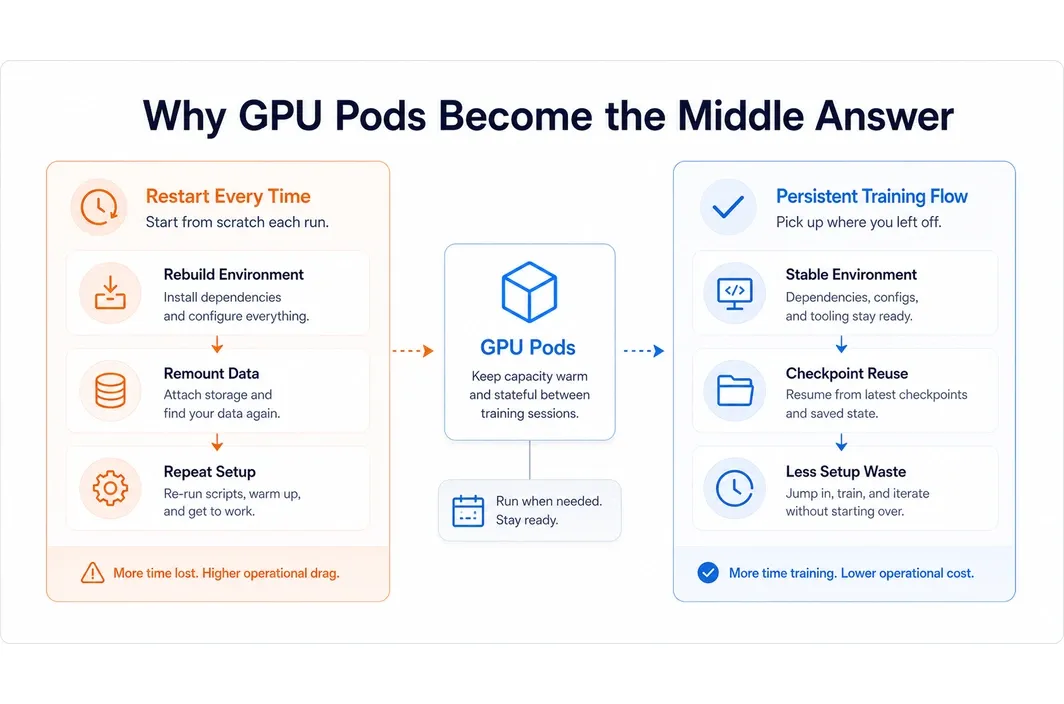
GPU Pods matter because they solve the part that many serverless vs dedicated articles skip. A lot of intermittent training workloads are not truly one-off, yet they are not active enough to justify a fully dedicated long-running instance either. This is where a persistent pod model becomes attractive. The environment stays closer to the workload. Datasets, checkpoints, and images do not need to be reinvented every time. Iteration becomes smoother, especially when the same team is returning to the same project repeatedly.
For AI teams, this middle layer is often more realistic than the extremes. The workflow may be intermittent in calendar terms but still repetitive in operational terms. In that case, the right comparison is not “how do we eliminate idle cost completely?” It is “how do we reduce repeated setup waste without turning the whole stack into a full-time infrastructure project?” That is why GPU Pods deserve to be treated as a real decision category, not just a side note.
This is also where category language matters. Many articles treat pods as if they were just another form of VM branding. That misses the point. The real reason pods matter for intermittent training is that they preserve more workflow continuity while keeping the environment lighter than a full dedicated-instances mindset. That distinction is exactly what a reader trying to make an infrastructure decision needs to see.
When Dedicated Instances Still Make Sense
Dedicated instances still win when the workload is frequent enough, stable enough, and demanding enough that persistent control becomes the main value. This usually happens when the training schedule is regular, the runtime environment is tightly controlled, or the team already operates with stronger internal platform standards. They also make sense when orchestration complexity is part of the normal workflow rather than an exception. If the team already knows it wants a deeper infrastructure footprint, the cost of that control may be justified.
The mistake is assuming that “intermittent” automatically rules out dedicated capacity. Some workloads are intermittent on a weekly calendar but operationally heavy enough that a dedicated environment still saves time and coordination. That is why the article should resist simplistic cost math. A dedicated instance may look inefficient if you only compare active GPU hours. It can still be the right answer if it eliminates enough surrounding friction in a mature training workflow.
| Decision factor | Serverless-style capacity | GPU Pods | Dedicated instances |
|---|---|---|---|
| Idle-cost sensitivity | Strong fit | Moderate fit | Weak fit |
| Repeated environment reuse | Weak fit | Strong fit | Strong fit |
| Workflow simplicity | Strong at small scale | Strong for repeated iteration | Depends on team maturity |
| Custom infrastructure control | Limited | Moderate | Strong |
| ## How RunC.ai Supports the Shift Between Training Modes |
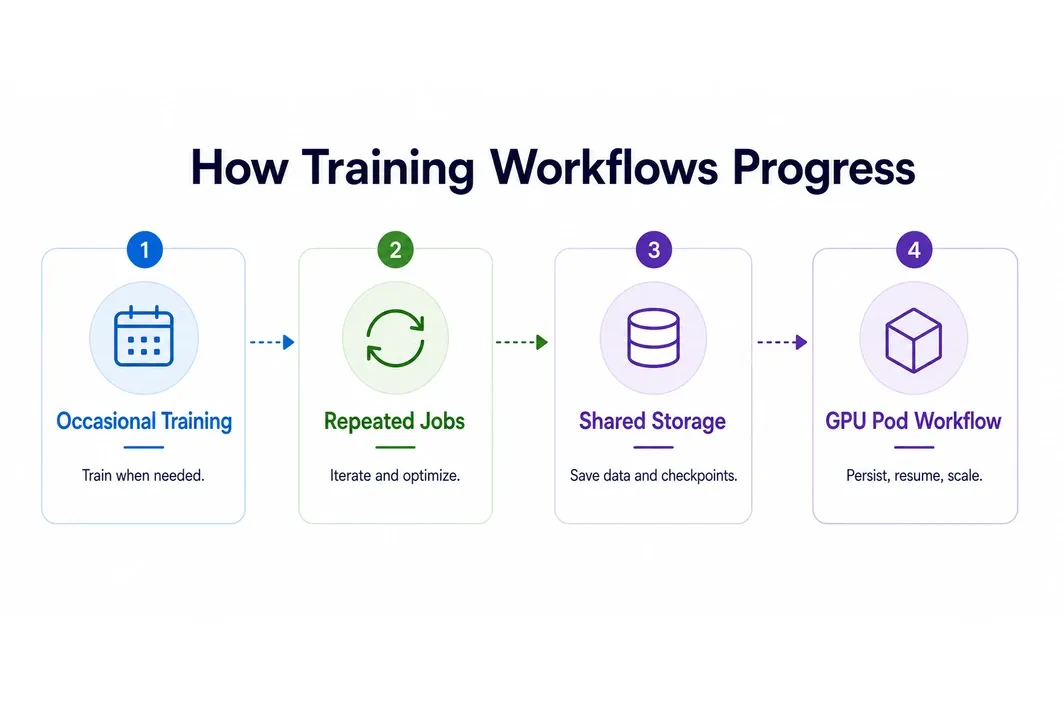
RunC.ai is useful here because it does not force the article into a fake binary. If the training pattern is occasional and the team is testing lightweight workflows, the serverless-style logic is easy to understand. If the workflow becomes repeatable and environment persistence starts to matter, GPU Pods become the practical next step. That makes RunC relevant as a workflow progression platform, not just a brand mention in the conclusion. Shared Network Volumes also help when intermittent training still depends on reusable datasets, model weights, or checkpoints across sessions.
The key is that the article should connect RunC to the real problem: reducing waste from the wrong deployment model. That is a much better fit than dropping in generic “flexible infrastructure” language. This positioning is also closer to the buyer's real question. They are not looking for abstract compute philosophy. They are looking for a way to stop overpaying, stop over-rebuilding, and stop choosing infrastructure that fights the shape of their training loop.
FAQ
Can intermittent AI training still justify dedicated GPU instances?
Yes. If the workflow is heavy, repeatable, and expensive to restart, dedicated infrastructure can still make sense even when jobs do not run continuously.
What is the biggest hidden cost in serverless training setups?
Repeated startup overhead is usually the biggest issue. That includes rebuilding environments, loading models, remounting data, and losing warm state between runs.
Why are GPU Pods often a better fit than pure serverless for repeated experiments?
Because the environment stays closer to the work. If the same team keeps returning to the same training loop, persistence often saves more time than strict zero-idle logic.
How should I think about checkpoint storage when training only a few times per week?
Think about reuse, not just frequency. If checkpoints and datasets keep returning to the workflow, storage behavior can matter as much as raw GPU billing.
Conclusion
Intermittent AI training is really a workflow-efficiency decision disguised as an infrastructure decision. If the workload is occasional and easy to restart, lighter on-demand capacity may be enough. If the environment keeps repeating, GPU Pods often become the smarter middle answer. If the workflow is heavy and stable, dedicated instances still deserve a serious look. That is the practical way to approach serverless vs dedicated instances intermittent ai training workloads. Choose the model that removes the most waste from the way your team actually trains, not the one that sounds cheapest in isolation, and use a platform like RunC.ai when you need to move between lighter and more persistent training modes.

Member discussion: