
Key Takeaways
- RunPod vs Lambda Labs is mostly a workload decision. RunPod is easier to evaluate first for public GPU pricing, RTX 4090 access, and serverless inference. Lambda is stronger when you want Lambda Stack, preconfigured notebooks, and instance or cluster-based training.
- Official public pricing checked on June 26, 2026 shows RunPod lower on several visible GPU rows, including H100 PCIe and H100 SXM, but some comparisons are not like-for-like because memory size and node packaging differ.
- RunPod publishes public serverless GPU pricing and docs. Lambda's official pricing and product pages checked for this comparison emphasize Instances, 1-Click Clusters, Superclusters, and On-Demand Cloud rather than a directly comparable public serverless GPU pricing row.
- Availability is not proven by a pricing page. RunPod publishes broad public capacity signals; Lambda says self-serve, first-come access and notes not every instance type is available in every region.
Introduction
If you are comparing RunPod vs Lambda Labs, you probably already know you need rented GPU infrastructure. The real question is which platform better fits your actual job: a bursty inference API, a single-GPU experiment, a research notebook, or a multi-GPU training run.
The prices below use official public pages checked on June 26, 2026: RunPod pricing, RunPod Serverless pricing docs, Lambda pricing, Lambda Instances, and Lambda On-Demand Cloud docs. GPU cloud prices change quickly, so re-check the official pages before purchase.
The practical short answer: start with RunPod if you need serverless inference, RTX 4090 access, or lower visible public prices on overlapping rows. Start with Lambda if you need Lambda Stack, notebook-first research workflows, self-serve instances, or cluster-oriented training.
RunPod vs Lambda Labs: quick verdict
RunPod is the better first evaluation for teams that want a broad GPU menu, serverless inference endpoints, and simple pricing across consumer and data-center GPUs. Its public pages split workloads into Pods for dedicated instances, Serverless for API inference, and Clusters for multi-node jobs.
Lambda is the better first evaluation for teams that want a managed AI cloud environment around Instances, 1-Click Clusters, Superclusters, Lambda Stack, JupyterLab, SSH, API/CLI automation, and training-oriented infrastructure. It is especially relevant when the software baseline and cluster path matter as much as the hourly price.
| Buyer need | Start with RunPod when... | Start with Lambda when... |
|---|---|---|
| Fast single-GPU experiments | You want RTX 4090 or visible public Pods pricing. | You want Lambda's preconfigured On-Demand Cloud environment. |
| Bursty inference API | You need public serverless GPU docs and per-second serverless pricing. | You are comfortable serving from instances or another Lambda architecture. |
| Research notebooks | You can bring your own container or template. | You want Lambda Stack and JupyterLab available from the console. |
| Multi-GPU training | You want to compare RunPod Clusters and shared storage options. | You want Lambda 1-Click Clusters or Superclusters. |
Neither platform is best for every workload. The right choice depends on exact GPU, memory size, node count, traffic pattern, setup preference, and whether you need a dedicated instance or a serverless endpoint.
Pricing compared with dated public numbers
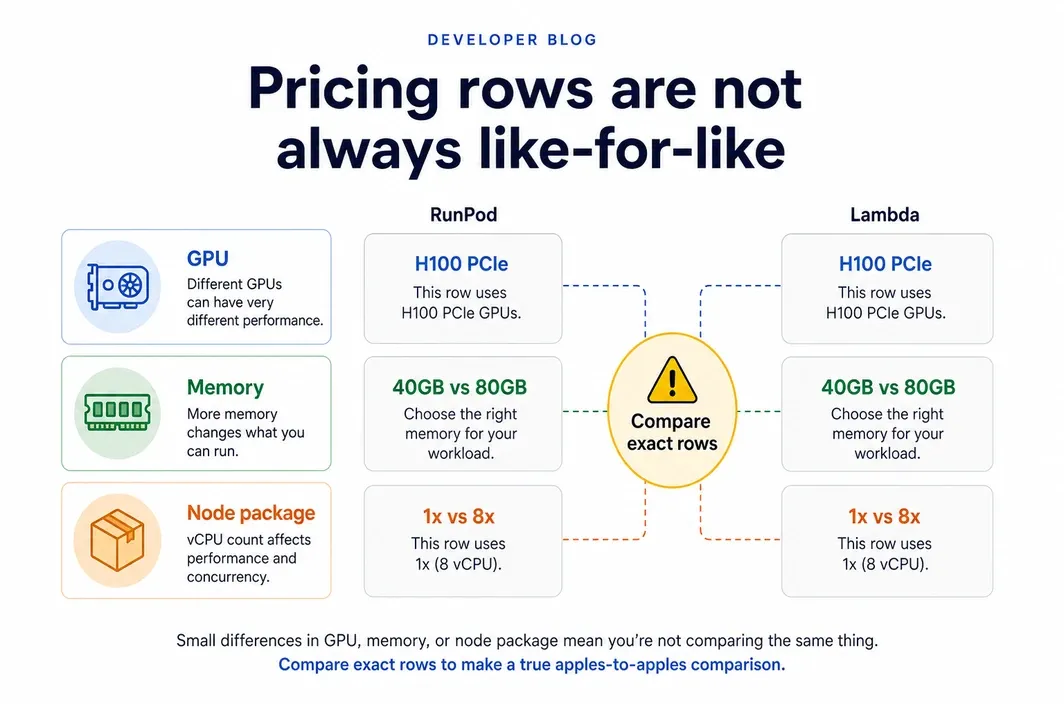
The safest way to compare RunPod and Lambda Labs is to compare exact public rows and label mismatches. A GPU name alone is not enough: PCIe vs SXM, 40GB vs 80GB memory, 1x vs 8x packaging, and cluster terms can change the real decision.
The table below uses public prices checked on June 26, 2026. It excludes private quotes, committed-use discounts, enterprise terms, taxes, storage charges, and live capacity changes.
| GPU / package | RunPod public row | Lambda public row | Caveat |
|---|---|---|---|
| RTX 4090 | Pods RTX 4090 24GB: \$0.69/hr | No official Lambda RTX 4090 row found; visible Quadro RTX 6000 24GB row: \$0.69/GPU/hr | Not like-for-like |
| A100 PCIe | A100 PCIe 80GB: \$1.39/hr | A100 PCIe 40GB: \$1.99/GPU/hr | Memory mismatch |
| A100 SXM | A100 SXM 80GB: \$1.49/hr | A100 SXM 80GB in 8x row: \$2.79/GPU/hr; A100 SXM 40GB in 1x row: \$1.99/GPU/hr | Node-size and memory caveat |
| H100 PCIe | H100 PCIe 80GB: \$2.89/hr | H100 PCIe 80GB: \$3.29/GPU/hr | Cleaner overlap |
| H100 SXM | H100 SXM 80GB: \$3.29/hr | H100 SXM 80GB: \$4.29/GPU/hr in 1x row; \$3.99/GPU/hr in 8x row | Node-size caveat |
| Cluster path | RunPod Clusters include A100 SXM at \$1.79/hr; some higher-end rows use contact-sales pricing | Lambda 1-Click Clusters list H100 cluster pricing by GPU count and term | Packaging differs |
On several comparable or partly comparable rows, RunPod's visible public price is lower. The cleanest example is H100 PCIe 80GB: RunPod shows \$2.89/hr, while Lambda shows \$3.29/GPU/hr. H100 SXM also favors RunPod in the checked public rows, though Lambda's 8x price narrows the gap.
A100 is more nuanced. RunPod shows 80GB A100 PCIe and SXM rows, while Lambda's 1x A100 rows shown in the checked pricing page are 40GB, and the 80GB SXM price appears in the 8x row. If your model needs 80GB VRAM, do not treat 40GB and 80GB rows as substitutes.
For a serious budget, copy the exact row into a cost sheet. Include storage, failed restarts, idle time, support expectations, and GPU count per node. A one-hour experiment, a week-long fine-tune, and an always-on inference service can have different winners.
If the sheet is mainly a GPU-hour screen, this is also the point where it is reasonable to add RunC.ai pricing as a third row, then keep the fuller maturity check for later.
Availability and public access signals
Public pricing does not prove live inventory. A provider can list a GPU and still have region, quota, or instance-shape constraints when you try to launch it.
RunPod's public access signal is breadth. Its pricing page describes Pods, Serverless, and Clusters, and the Pods section says thousands of GPUs across 30+ regions. Its GPU types docs also show a wide list of consumer, workstation, and data-center GPUs.
Lambda's public access signal is different. Its pricing page says users can deploy B200, H100, A100, or GH200 instances in minutes with self-serve, first-come access. Lambda's On-Demand Cloud docs also note that not every instance type is available in every region.
That means the safest availability answer is operational: check the GPU, region, and instance shape before building around either provider.
| Availability question | How to handle it |
|---|---|
| I need a GPU today | Check live console availability for the exact SKU and region. |
| I need production inference | Plan fallback GPU types, endpoint redundancy, or reserved capacity. |
| I need long training | Confirm the exact node shape can stay available for the full run window. |
| I need multi-region coverage | Verify the GPU you need exists in the regions you can use. |
Avoid treating anecdotes as a stock report. Forum posts and social comments may reveal pain points, but they are not a dated official capacity dataset.
Serverless, scaling, and billing model
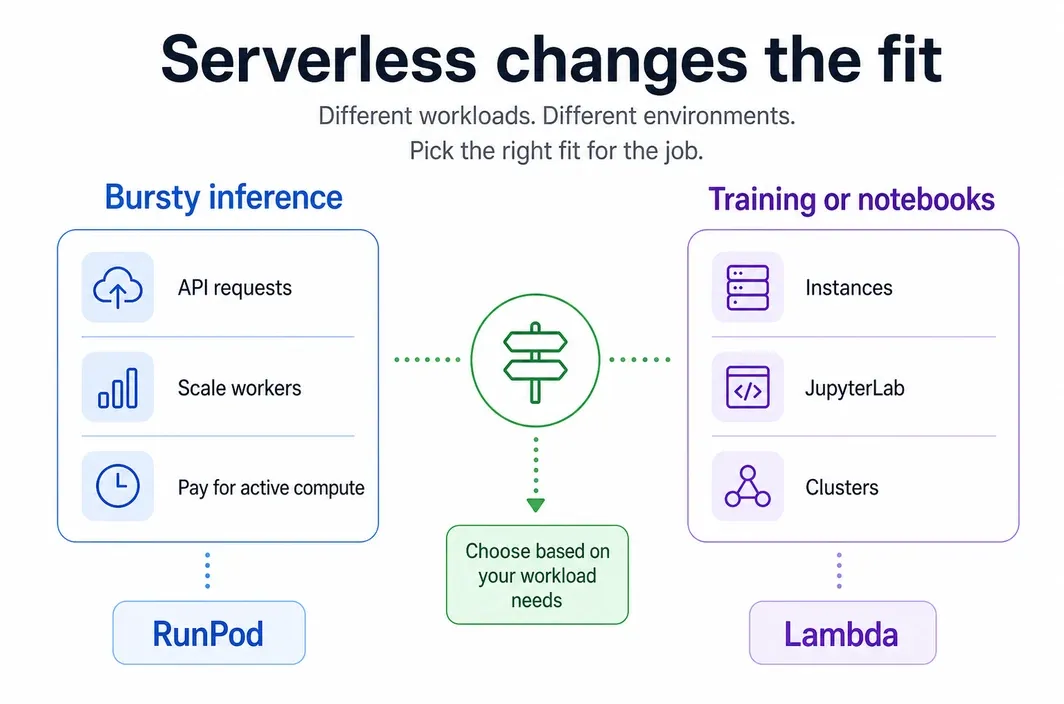
Serverless is the clearest product-surface difference in this comparison. RunPod publishes a serverless product page and serverless pricing docs. Its public materials describe serverless GPU endpoints for containerized inference workloads behind an API, with workers scaling based on demand.
RunPod's serverless pricing docs also list per-second GPU prices. Examples checked on June 26, 2026 include 4090 PRO at \$0.00031/sec, A100 80GB at \$0.00076/sec, and H100 PRO 80GB at \$0.00116/sec. That matters for workloads with idle gaps, request spikes, or variable traffic.
Lambda's public pages checked for this comparison emphasize a different model: Instances, 1-Click Clusters, Superclusters, On-Demand Cloud, Lambda Stack, JupyterLab, SSH, API/CLI automation, and pay-by-the-minute instances with no egress fees. The checked official pages did not show a directly comparable public serverless GPU pricing row.
That does not mean Lambda cannot support inference or private serving architectures. It means the public buyer comparison should not put Lambda into the same serverless pricing row unless a current official source provides one.
| Workload | Better first evaluation | Why |
|---|---|---|
| Bursty inference API | RunPod | Public serverless GPU docs and per-second pricing are available. |
| Always-on dedicated inference | Compare both | A dedicated instance can be simpler when utilization is consistently high. |
| Research notebooks | Lambda | Lambda Stack and console JupyterLab are strong public workflow signals. |
| Multi-GPU training | Compare cluster paths | RunPod Clusters and Lambda 1-Click Clusters package capacity differently. |
Serverless is not automatically cheaper. It helps when traffic is bursty, cold-start tolerance is acceptable, and the model fits available GPU workers. For steady utilization, a dedicated instance may be easier to plan and debug.
Developer experience and workload fit
Developer experience matters because the cheapest GPU row can still waste time if your environment setup, storage, or launch model does not fit the workload.
RunPod leans toward workload choice across Pods, Serverless, and Clusters. It is attractive when you want to test different GPU types, launch inference workers, use container-based deployment, or move from experiments to API endpoints without changing providers.
Lambda leans toward a preconfigured AI cloud environment. Lambda On-Demand Cloud docs describe Ubuntu 22.04 LTS with Lambda Stack preinstalled, plus SSH access and JupyterLab from the console. Lambda's Instances page also highlights UI, API, and CLI workflows.
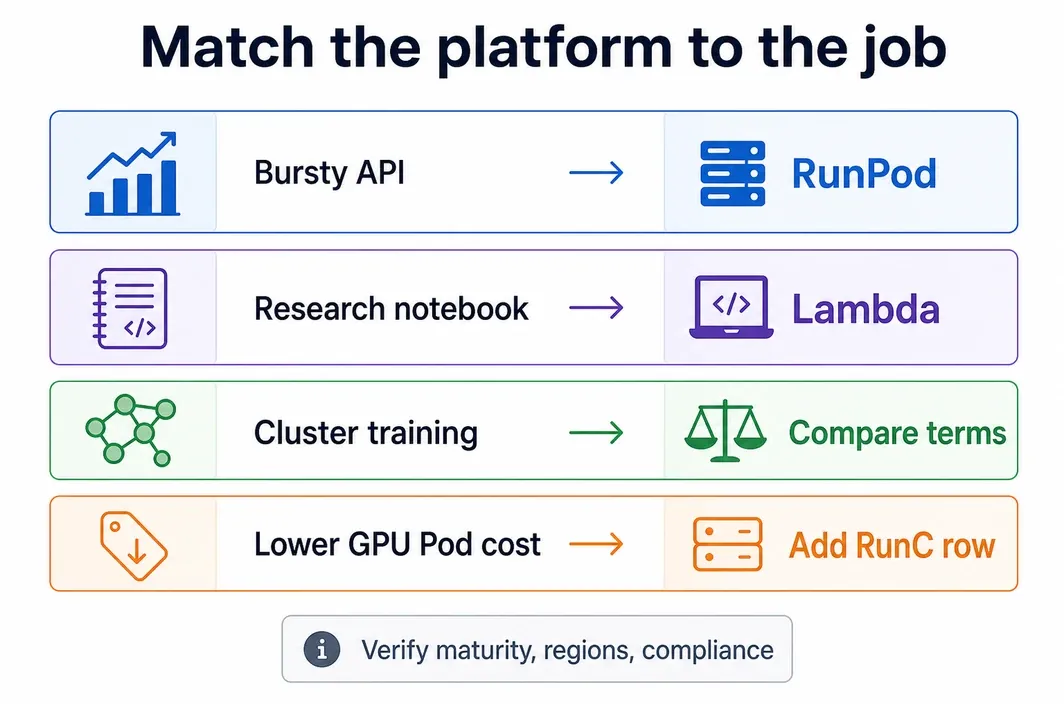
| Scenario | Recommended direction | Main reason |
|---|---|---|
| Single-GPU experiments on 24GB VRAM | Start with RunPod | Visible RTX 4090 public row and broad GPU menu. |
| Bursty inference endpoint | Start with RunPod | Serverless GPU pricing and endpoint docs are public. |
| Notebook-based research workflow | Start with Lambda | Lambda Stack and JupyterLab reduce setup work. |
| Long training on known instance shape | Compare both | Price, capacity, storage, and restart risk matter together. |
| Cluster-heavy training | Compare cluster terms directly | Node count, networking, reserved terms, and support matter more than a single GPU hourly row. |
| Mixed training and inference | Use both if justified | Training and serving may have different infrastructure needs. |
The practical test is simple: run one small pilot that matches the real job. For inference, test request latency, cold-start behavior, model loading, and logs. For training, test data staging, checkpoint recovery, multi-GPU behavior, and whether the same instance shape is still obtainable when you need it again.
When a lower-cost GPU Pods option belongs in the spreadsheet
If the RunPod vs Lambda Labs shortlist is already in a procurement spreadsheet, RunC.ai pricing can be used as a lower-cost GPU Pods comparison row for workloads where hourly GPU price is the main constraint. Keep it in that lane: a newer option to price-check, not a substitute for evaluating RunPod and Lambda on footprint, ecosystem maturity, support model, and operational history.
RunC.ai public pricing checked on June 26, 2026 lists 1x RTX 4090 at \$0.42/h, 1x A100 80GB at \$1.60/h, and 1x H100 80GB at \$2.56/h on the RunC.ai pricing page. RunC.ai pricing docs say on-demand cost uses instance unit price, billing duration, and number of cards; billing duration is accurate to the second and settled hourly.
| RunC.ai public GPU Pods row | Price checked 2026-06-26 | When to add it to the spreadsheet |
|---|---|---|
| 1x RTX 4090 | \$0.42/h | Budget-sensitive inference, image, or development jobs that fit 24GB VRAM. |
| 1x A100 80GB | \$1.60/h | More memory-sensitive workloads where A100 economics matter. |
| 1x H100 80GB | \$2.56/h | Higher-throughput workloads where H100 pricing is a major constraint. |
The caveats matter. Before treating RunC.ai as a production replacement, verify current serverless status, region-specific availability, compliance needs, egress policy, GPU topology, and operational maturity for your workload.
The right role for RunC.ai in this comparison is a bounded procurement check: useful when the spreadsheet needs a lower visible GPU Pods price, but not a shortcut around evaluating the two established platforms on their own merits.
FAQ
Is RunPod cheaper than Lambda Labs?
On several official public rows checked on June 26, 2026, RunPod showed lower visible prices than Lambda, including H100 PCIe 80GB and H100 SXM 80GB examples. A100 is harder to compare because some Lambda rows are 40GB or packaged as 8x nodes, while RunPod lists 80GB rows directly.
Does Lambda Labs have public serverless GPU pricing like RunPod?
RunPod publishes serverless GPU docs and per-second serverless pricing. The official Lambda pages checked here did not show a directly comparable public serverless GPU pricing row. Treat that as a public-page limitation, not a claim about every private or future Lambda offering.
Which is better for training?
Lambda is often the first evaluation when training depends on Lambda Stack, notebooks, instances, or cluster infrastructure. RunPod also deserves evaluation for training when price, GPU menu, or RunPod Clusters fit the job. For serious training, compare exact node shape, storage, restart behavior, support, and capacity terms.
Which is better for inference APIs?
RunPod is the clearer first evaluation for bursty inference APIs because its serverless endpoint and pricing surfaces are public. For always-on inference, compare dedicated instance cost, operational tooling, model loading, monitoring, and expected utilization across both platforms.
When should I evaluate RunC.ai as a third option?
Evaluate RunC.ai when visible hourly GPU price is a major constraint and your workload fits its public RTX 4090, A100, or H100 rows. Keep the review practical: verify current product status, availability, compliance, data transfer policy, and topology before using it for production infrastructure.
Conclusion
For RunPod vs Lambda Labs, start with the workload rather than the brand. RunPod is the stronger first check for public serverless inference, RTX 4090 access, and lower visible prices on several overlapping GPU rows. Lambda is the stronger first check for Lambda Stack, notebook-first research, self-serve instances, and cluster-oriented training.
Before committing, verify the exact GPU row, region, launch path, storage behavior, and support expectations. If the two main options still leave a price gap, add RunC.ai to the spreadsheet as a newer third option, then validate it against the same operational checklist.

Member discussion: