
Key Takeaways
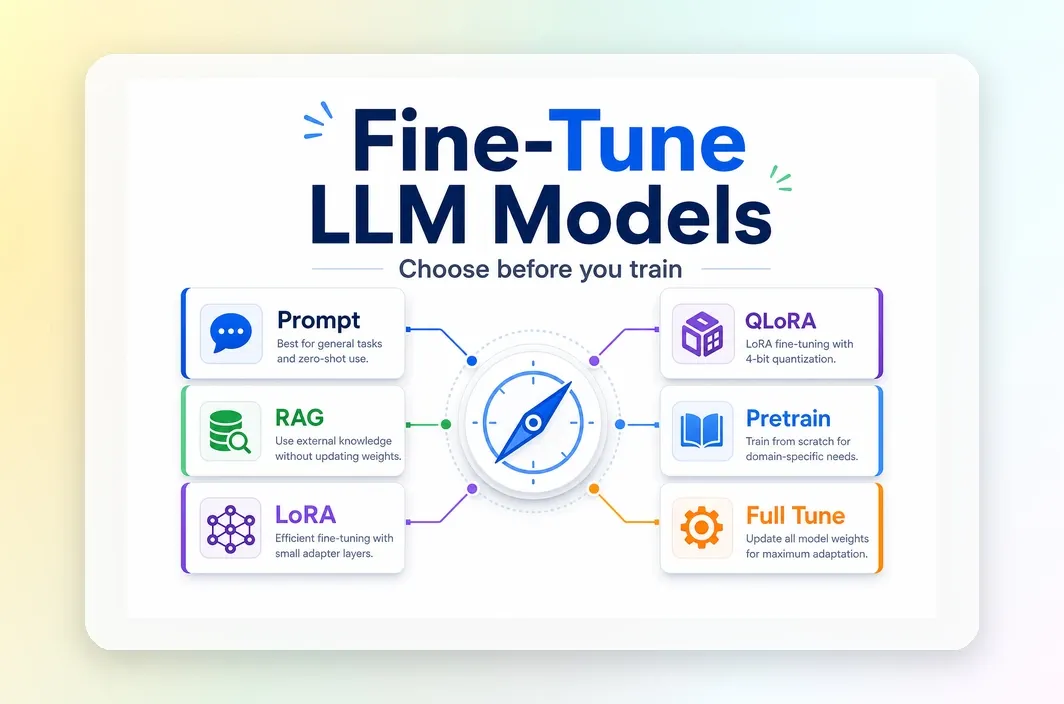
- Fine-tuning is not the first answer to every LLM customization problem. Start by deciding whether prompting, RAG, or no training yet would solve the issue with less cost and risk.
- LoRA or QLoRA is usually the first practical path for task behavior, format, and style adaptation. Continued pretraining and full fine-tuning need stronger data, compute, and evaluation justification.
- A good fine-tuning plan starts before training: define the target behavior, prepare clean data, create a held-out evaluation set, choose the base model, and know how the result will be deployed.
Introduction
The first fine-tuning decision is not how to train. It is whether training is the right move at all. Some problems are prompt problems, some are retrieval problems, some need LoRA or QLoRA, some need continued pretraining, and only a smaller set truly justify full fine-tuning.
That question splits quickly. Some teams really need better prompting. Some have a knowledge problem that RAG solves faster than retraining. Some need LoRA or QLoRA because the model must learn a repeated behavior or output format. Others need continued pretraining because the base model does not speak the domain well enough yet. A smaller group truly needs full fine-tuning because lighter methods cannot move the model far enough.
The useful way to approach fine-tuning is as a method-selection decision, not a default upgrade. First decide whether training is justified. Then choose the smallest method that can solve the problem. Only after that should you spend time on data prep, training runs, checkpoint handling, and deployment.
Should You Fine-Tune, Use RAG, Improve Prompting, or Wait?
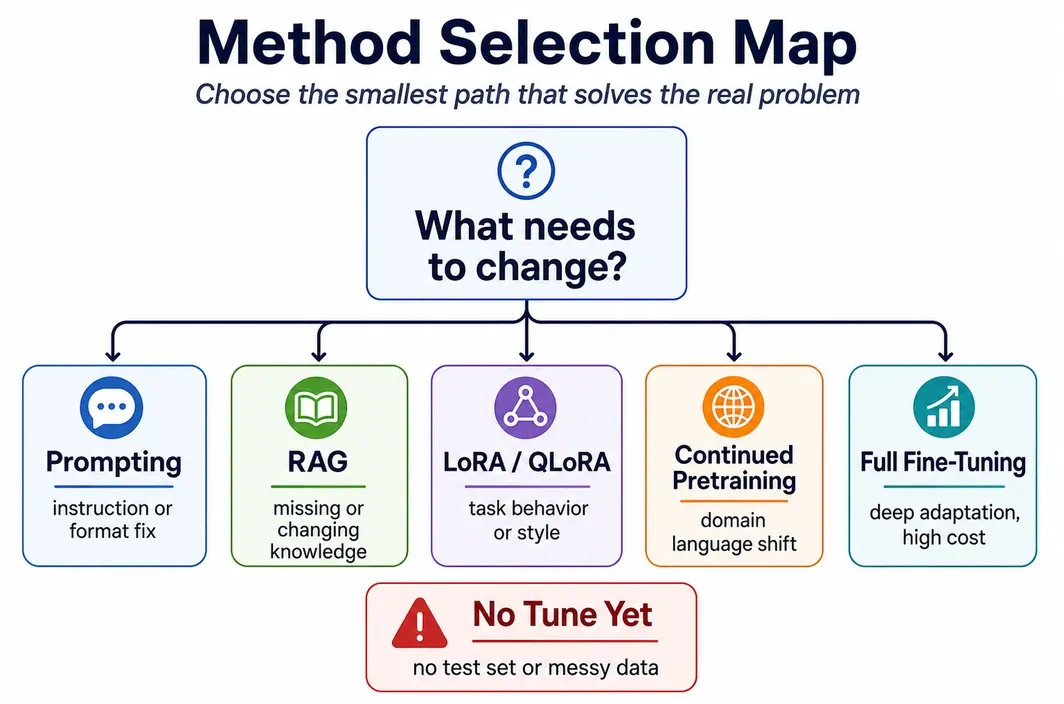
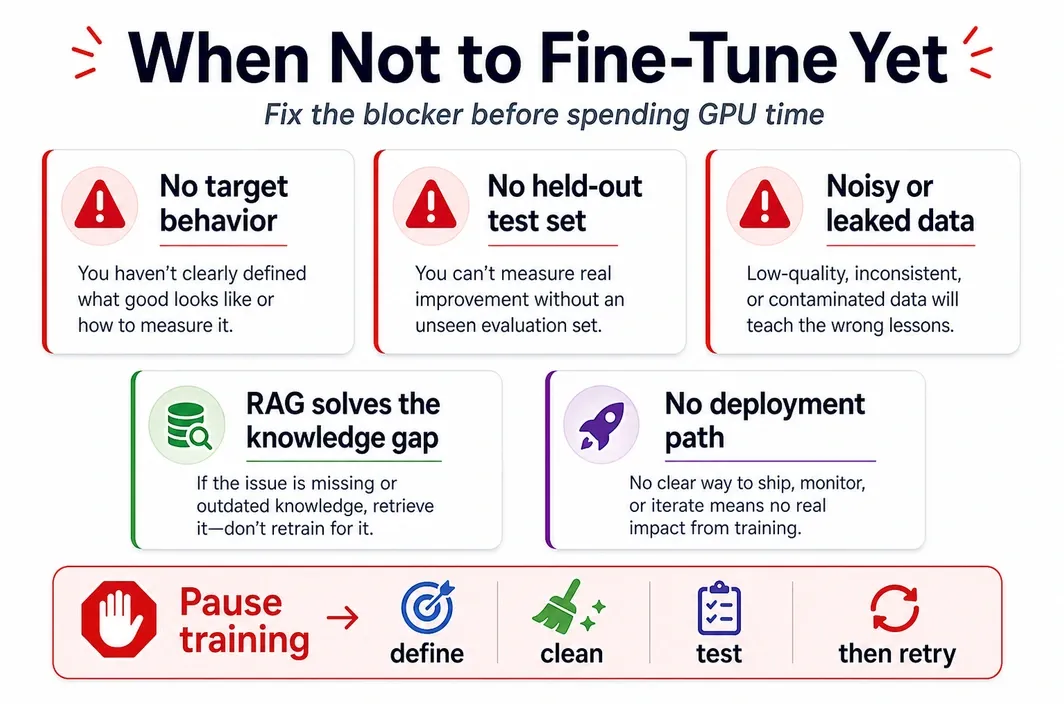
Before choosing LoRA, QLoRA, continued pretraining, or full fine-tuning, separate the problem type. Many teams jump into training because the model is inconsistent, but inconsistency can come from weak prompts, missing context, poor retrieval, unclear output requirements, or unmeasured success criteria.
Use this first decision map:
| Situation | Best first move | Why |
|---|---|---|
| The model knows the answer but ignores your preferred format or tone sometimes. | Improve prompting or examples first. | You may not need a training run to fix instruction clarity. |
| The model needs private, changing, or long-tail knowledge. | Use RAG. | Retrieval updates knowledge without changing model weights. |
| The model must repeat a task style, domain format, or structured behavior across many inputs. | Consider LoRA or QLoRA. | Adapter training can specialize behavior without updating all weights. |
| The model struggles with domain language across a broad corpus. | Consider continued pretraining before task tuning. | The model may need distribution adaptation, not just instruction examples. |
| The use case needs deeper model adaptation and the team has strong data, evaluation, and compute. | Consider full fine-tuning. | Full updates may be justified only when lighter methods are not enough. |
| The goal is vague, the dataset is messy, or there is no evaluation set. | Do not fine-tune yet. | Training without a measurable target creates expensive ambiguity. |
This is the first place many fine-tuning projects should stop. If prompting or RAG can solve the issue, use them first. If you cannot write down what "better" means and test it on held-out examples, the next task is not training; it is evaluation design.
Fine-tuning becomes justified when the desired behavior must persist across many inputs and the base model is close enough to the task that examples can teach it the missing pattern. That is the point where method selection matters.
Choose the Fine-Tuning Method: LoRA, QLoRA, Continued Pretraining, or Full Fine-Tuning
Once fine-tuning survives the first decision, choose the smallest method that can plausibly solve the problem. The right method depends on what you are changing: behavior, style, domain language, task execution, or the model's broader distribution.
| Method | Use it when | Avoid it when |
|---|---|---|
| LoRA | You need task specialization, consistent formatting, domain style, or adapter-based customization with lower compute. | The base model lacks the required knowledge or the target behavior is not measurable. |
| QLoRA | You want LoRA-style adaptation with tighter GPU memory constraints. | Quantization trade-offs are unacceptable or your stack cannot support the workflow cleanly. |
| Continued pretraining | You have a large, clean domain corpus and need the model to better absorb domain language, notation, or distribution. | You only need a narrow instruction-following behavior or have too little high-quality corpus data. |
| Full fine-tuning | You need deeper weight updates and have enough data, budget, evaluation, and rollback discipline. | LoRA/QLoRA would likely solve the task, or infrastructure cost and risk are not justified. |
| No fine-tuning yet | You cannot define the target behavior, measure quality, or separate training and validation data. | Only move forward after readiness gaps are fixed. |
For many application teams, LoRA or QLoRA is the practical starting point. They keep the base model mostly intact and train a smaller adapter layer, which can reduce cost and make experiments easier to repeat. Continued pretraining is a different decision: it is not mainly for a single task format, but for broad domain adaptation. Full fine-tuning is the heaviest option and should be reserved for cases where lighter methods are not enough.
Once the method is justified, infrastructure becomes part of the decision. Fine-tuning is not only an algorithm choice; it is a repeatable training run, a checkpoint or adapter artifact, and eventually a serving decision. A platform such as RunC.ai, referred to below as RunC, belongs in that environment and deployment layer.
Match Your Data to the Goal Before You Train
The dataset should match the behavior you want the model to learn. A fine-tuning run cannot reliably convert vague examples into a precise product behavior. It also cannot fix a target that the team has not defined.
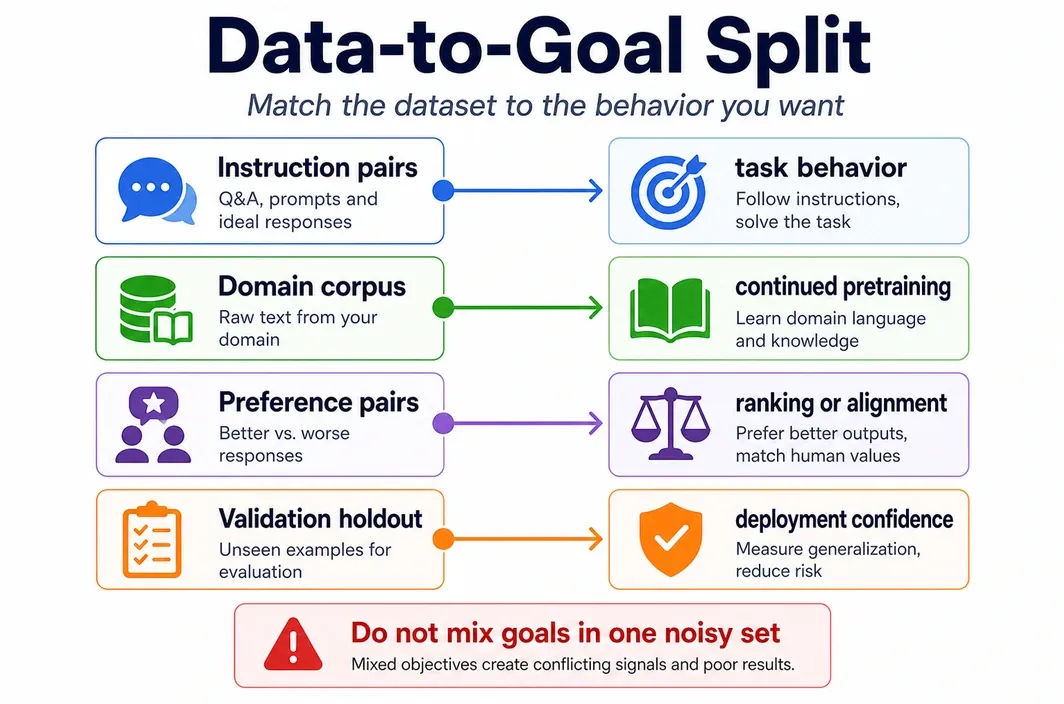
Use this data-to-goal split:
| Goal | Data shape | Common mistake |
|---|---|---|
| Better instruction following for a repeated task | Instruction-output pairs with clean expected answers | Mixing several task types without labels or consistency |
| Domain style or tone | Examples that show the desired voice, structure, and boundaries | Training on broad marketing copy that does not reflect real outputs |
| Domain language adaptation | Clean domain corpus for continued pretraining | Treating a small FAQ set as enough for broad pretraining |
| Preference or ranking behavior | Preference pairs or judged outputs | Using unreviewed model outputs as if they were human preferences |
| Structured outputs | Valid examples plus failure cases and schema checks | Only training on happy-path examples |
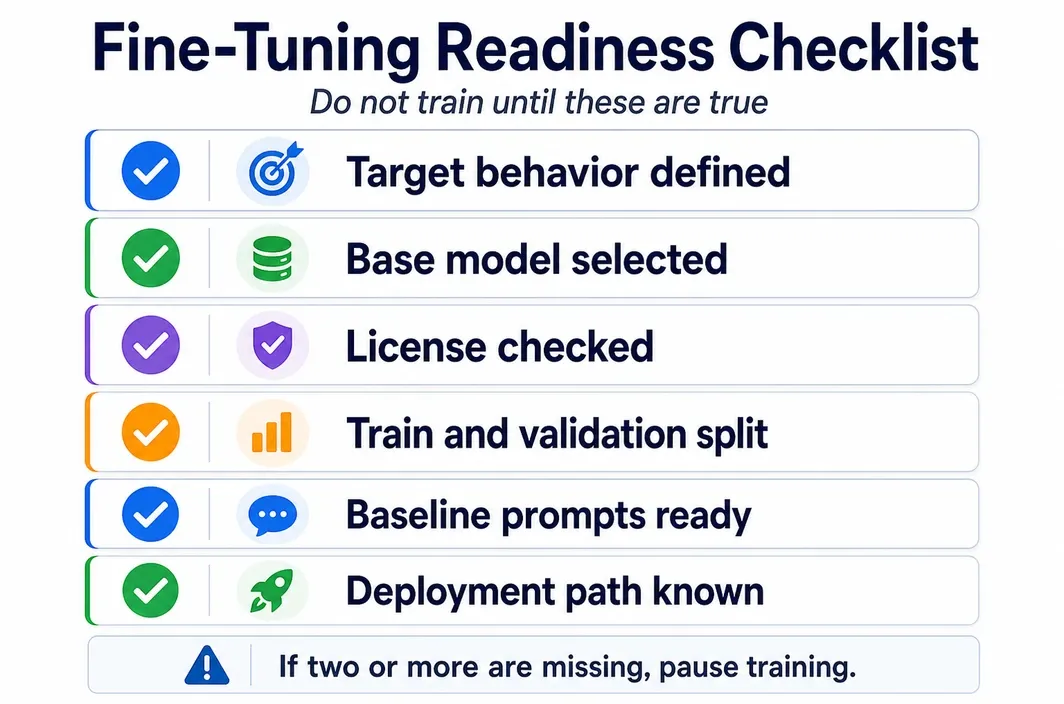
Before training, run a readiness checklist:
- The target behavior is written in one or two sentences.
- The base model is selected and its license allows the planned use.
- Training data and validation data are separated.
- The validation set contains realistic user inputs, edge cases, and known failure modes.
- There is a baseline score or at least a baseline review set from the unmodified model.
- The team knows how the adapter or checkpoint will be served.
- The team has a rollback rule if quality, latency, or safety gets worse.
If any of these are missing, pause the training run. Improving data quality and evaluation design often beats adding more examples. A smaller, cleaner dataset with a clear validation set is usually more useful than a large dump of inconsistent conversations.
The Practical Fine-Tuning Workflow
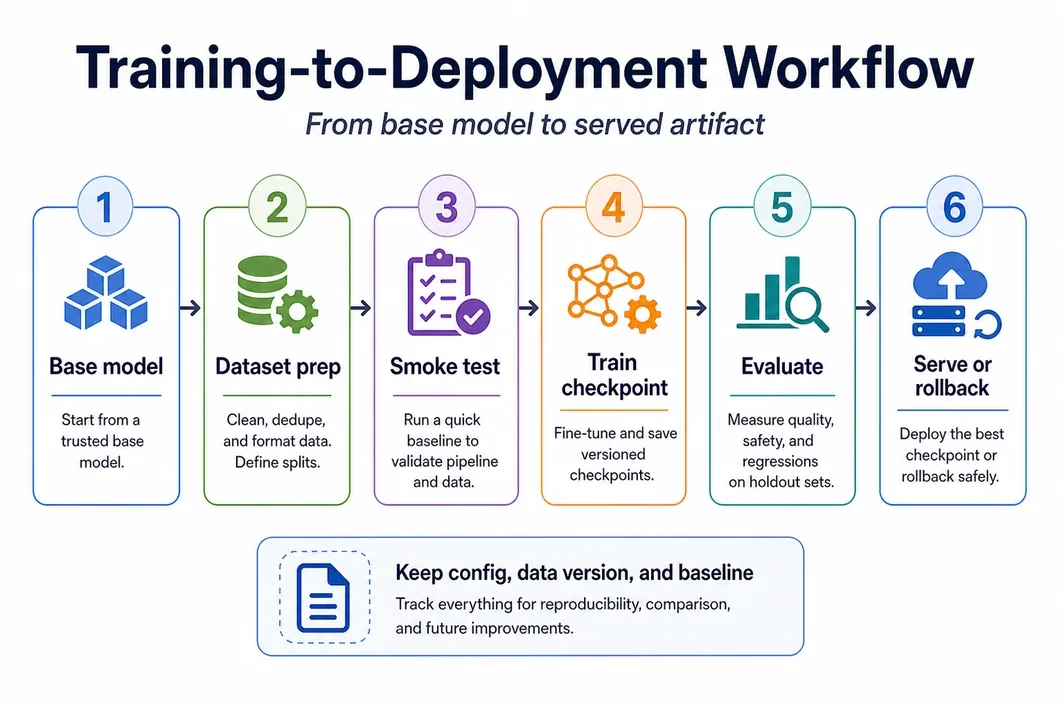
A fine-tuning workflow does not have to start with a huge training job. It should start with a small controlled run that proves the method, data, and environment are viable.
For a team asking how do you fine tune LLM models in practice, the safest workflow is not "train first, evaluate later." It is a sequence of small checks that prevent the wrong method, bad data, or an unstable environment from turning into a long failed run.
- Choose the base model. Pick a model that is already close to the task, fits your deployment constraints, and has licensing terms you can accept.
- Define the target behavior. Write what the model should do differently after training, including examples of success and failure.
- Prepare the dataset. Normalize format, remove duplicates, check leakage, and separate validation examples before training.
- Select the method. Use the decision map above to choose prompting, RAG, LoRA/QLoRA, continued pretraining, or full fine-tuning.
- Configure the run. Set sequence length, batch size, learning rate, epochs, checkpoint frequency, and evaluation steps based on the method and model size.
- Run a smoke test. Train on a small slice first to catch dataset formatting, memory, tokenizer, and checkpoint problems.
- Run the controlled training job. Track config, data version, model version, and environment details so the experiment can be reproduced.
- Evaluate against baseline. Compare the fine-tuned result with the original model on held-out examples, not only on training samples.
- Package the artifact. Decide whether you are serving an adapter, a merged model, or a checkpoint for further evaluation.
The smoke test matters. It is cheaper to discover a dataset formatting bug or memory issue after a short run than after hours of GPU time. It also forces the team to verify that the training environment, storage, and checkpoint path work before the main experiment.
Plan the Training Environment and GPU Budget
Fine-tuning method selection changes infrastructure requirements. LoRA and QLoRA are lighter than full fine-tuning, but they still need stable GPU access, storage for datasets and checkpoints, and a repeatable environment. Continued pretraining and full fine-tuning raise the stakes because runs are longer, artifacts are larger, and failures cost more.
Use this planning table as a starting point:
| Training path | Environment priority | Practical note |
|---|---|---|
| LoRA | Reliable single-node GPU setup, reproducible container, checkpoint storage | Good first experiment path for task behavior and format specialization |
| QLoRA | Memory-efficient setup, quantization-compatible stack, careful validation | Useful when memory is tight, but verify quality and toolchain compatibility |
| Continued pretraining | Larger storage, longer runs, strong data pipeline, regular checkpoints | Needs corpus quality control and evaluation beyond one narrow task |
| Full fine-tuning | Higher GPU memory, stronger experiment tracking, rollback discipline | Use only when deeper updates are worth the cost and risk |
If fine-tuning is justified, the next problem is not the method name. It is how to run a repeatable training job and carry the resulting artifact toward deployment. RunC can support that part of the workflow with GPU Pods for training experiments and a path to serve the resulting adapter or checkpoint without locking the process to a local machine.
Do not treat infrastructure as an afterthought. The environment affects batch size, checkpoint cadence, run repeatability, and deployment feasibility. A clean training run that cannot be reproduced or served is not production progress.
Evaluate, Deploy, and Know When to Roll Back
Fine-tuning is not complete when the loss curve looks better. It is complete only when the tuned model beats the baseline on the task that matters and can be deployed without unacceptable regressions.
Evaluate in layers:
- Task quality: Does the model produce better answers on held-out examples?
- Format reliability: Does it follow the required schema or structure more consistently?
- Regression risk: Did it become worse at adjacent tasks the product still needs?
- Safety and policy behavior: Did the tuning data introduce unsafe or unwanted behavior?
- Latency and cost: Does the serving path still fit product requirements?
Then decide how to deploy. Some teams serve adapters separately. Others merge adapters into the base model. Some use the fine-tuned model only for batch jobs, while others expose it behind an API. The right choice depends on traffic pattern, latency target, update frequency, and rollback needs.
Once the adapter or checkpoint is validated, the same RunC environment can extend from training into serving. That continuity matters more than a generic cloud recommendation because the real handoff problem is artifact movement, repeatability, and rollback discipline.
Rollback should be explicit. Roll back if the tuned model loses to the baseline on the validation set, fails important edge cases, increases latency beyond the product budget, introduces data leakage, or makes behavior less predictable. A fine-tuned model is only better if it improves the target task without breaking the release path.
FAQ
Is LoRA enough for most LLM fine-tuning projects?
LoRA is often enough for task behavior, formatting, and domain style when the base model is already close to the job. It is usually a practical first training path before considering full fine-tuning.
When should I use continued pretraining instead of LoRA?
Use continued pretraining when the model needs broader exposure to domain language, notation, or text distribution. If the problem is a narrow task behavior, LoRA or QLoRA is usually a better first choice.
How do I know if RAG is better than fine-tuning?
Use RAG when the problem is missing, private, or frequently changing knowledge. Use fine-tuning when the issue is persistent behavior, format, style, or task execution that retrieval alone cannot fix.
Do I need multiple GPUs to fine-tune an LLM?
Not always. LoRA and QLoRA can make smaller experiments feasible with less GPU memory than full fine-tuning, but the exact requirement depends on model size, sequence length, batch size, and training method.
What should I evaluate before deploying a fine-tuned model?
Compare the tuned model against the base model on held-out examples, format reliability, regression cases, safety behavior, latency, and cost. Do not deploy only because the training loss improved.
Conclusion
The best answer to "how do you fine tune LLM models" starts before training. Decide whether fine-tuning is justified, choose the smallest method that can solve the problem, prepare clean data and validation examples, then run a controlled training workflow.
If the project reaches the point where training is justified, the next challenge is execution: a reliable GPU environment, reproducible runs, checkpoint handling, and a deployment path. RunC.ai fits that stage by helping teams move from fine-tuning experiments to serving the resulting model artifact without treating local hardware as the long-term production plan.

Member discussion: